Bedtime Stories in Your Own Voice - Personal AI Storytelling
Bedtime Stories in Your Own Voice can help keep a familiar part of bedtime close when work, travel, or distance gets in the way. With consent-based AI voice cloning, a parent can create story narration that sounds familiar, choose suitable reading material, review the audio, and give a child something personal to hear.
What Are Bedtime Stories in Your Own Voice?
Bedtime Stories in Your Own Voice are audio stories narrated with a recording or an authorised custom AI voice that resembles you. Instead of choosing only a standard narrator, a parent can use a familiar voice for story time, even when they cannot sit beside the child that evening.
The idea is simple, but it can mean different things. Some parents record whole stories themselves. Others use AI voice cloning so their voice can read authorised text they did not personally record line by line. The second option is useful when a story is long or when a parent wants to prepare several listening choices.
This does not turn AI into a replacement parent. A generated voice cannot answer a child's unexpected question, notice a worried expression, or share a laugh in real time. It is better understood as another form of personalised audio that can support a bedtime routine when normal reading is not possible.
How Can AI Read a Bedtime Story in Your Voice?
AI voice cloning learns patterns from a clear voice recording and uses those patterns during speech generation. The system can then read new text while aiming to keep recognisable features of the speaker's voice, such as tone, rhythm, accent, and pacing.
Different services use different processes and recording requirements. For Hoowooh, the current custom voice guidance is roughly 40–50 minutes of clear audio from the speaker, with consent. The goal is to create a private custom voice that can be used for audiobook narration.
Record or Create Your Custom Voice
Start with clean speech. Record in a quiet place and keep the microphone at a steady distance. Natural reading is more useful than trying to sound like a radio presenter. Clear pronunciation and varied sentences help capture how you normally speak.
If another family member will provide the voice, get their clear permission first. A grandparent's old recording may feel meaningful, but possession of a recording is not the same as permission to build a reusable AI voice from it.
Choose the Story
Next, choose material you have the right to use. That might be your own story, a suitable text you are authorised to convert, or supported book content for personal listening. Think about the child's age, interests, attention span, and normal bedtime habits.
With Hoowooh, the focus is on turning supported book content into listenable audio rather than automatically writing a new children's story. That distinction is useful for parents who already know what they want their child to hear.
Generate the Narration
Once the text and voice are ready, AI narration turns the written words into speech. A good result needs more than voice similarity. Pauses, sentence endings, emphasis, dialogue, and pace all affect whether a bedtime story feels calm and easy to follow.
Listen and Review Before Bedtime
Always listen before giving the audio to a child. Check names, unusual words, story content, pacing, and volume. A five-minute review can catch an odd pronunciation or a section that feels too intense for bedtime.
Why Parents Create Bedtime Stories in Their Own Voice
The biggest reason is often continuity. Children can become used to a particular bedtime rhythm: pyjamas, a drink of water, one story, a goodnight phrase, then lights out. When a parent is suddenly away, even a small familiar part of that routine may feel worth keeping.
Bedtime Stories in Your Own Voice can also make ordinary listening feel more personal. A child may already know the narrator as Mum, Dad, a grandparent, or another trusted family member. The story is not only about the characters on the page; the voice itself has a family connection.
Parents may also want a small library of family stories for repeat listening. A favourite tale can stay available on busy nights without requiring the parent to create a fresh recording every time.
Bedtime Stories in Your Own Voice When You Can't Be There
This is where the idea becomes most practical. A parent may travel for work, finish a late shift, live in another home, spend time in hospital, work abroad, or be away for another reason. The child can still hear a familiar story voice without pretending that the audio is the same as having the parent physically present.
Shared parenting is another example. A child may move between homes during the week. A story narrated in the other parent's authorised voice can preserve a small part of a familiar routine. The same idea can work during sleepovers with grandparents or other trusted carers.
For longer periods away, parents can prepare several stories instead of repeating one recording every night. Variety keeps the listening experience fresh while the familiar voice remains consistent.
- Work travel or overnight shifts that regularly overlap with bedtime.
- Shared parenting when a child spends nights in more than one home.
- Hospital stays, deployment, or longer periods when a parent is away.
- Sleepovers with grandparents or trusted family members.
- Busy evenings when a prepared story can support the usual bedtime routine.
Can You Personalise a Bedtime Story for Your Child?
Personalisation does not have to mean asking AI to invent everything. You can choose stories that match your child's interests, current routines, or favourite types of characters. A child who loves space may enjoy a gentle space adventure, while another may prefer animals, trains, fairy tales, or familiar family stories.
If you create or own the text yourself, you can include a child's name or small family details before generating the narration. Keep the story simple enough for the child's age and avoid adding personal information that does not need to be stored in a service.
A familiar voice can be the strongest personal element on its own. You do not need to turn every story into a highly customised AI experience for it to feel special.
Can You Use Your Child's Favourite Book?
Parents naturally want to use books their children already love. However, owning a copy of a book does not automatically give permission to publish, sell, or distribute a new audiobook version. The intended use and rights around the material matter.
For personal listening, use content you are allowed to convert under the platform's rules and applicable rights. Hoowooh tells users to upload books and documents they own or are authorised to use and does not support DRM-protected ebooks.
If a favourite book cannot be used, consider your own original story, authorised material, or another book that can be converted appropriately. The goal is a comforting listening experience without ignoring the rights attached to the story.
Can Both Parents Create Their Own Bedtime Story Voices?
Yes, where the platform supports separate authorised custom voices. Each person should create their own voice with clear consent. That gives families flexibility: one night a story may sound like Mum, another may sound like Dad, and another can use a standard narrator.
Keeping voices separate also makes consent easier to understand. One parent's permission should not be treated as permission for another person's voice. Each speaker should know how their recording will be used and who can access the resulting voice model.
What About Grandparents and Other Family Voices?
A grandparent's voice can make family stories especially personal. A grandparent might narrate a childhood tale, a family memory, or a story the child already loves. The same can apply to another trusted adult who is part of the child's bedtime life.
Consent still comes first. Ask the speaker directly before creating a custom voice. If the person is no longer able to consent, the situation becomes more sensitive. Families may have strong feelings about preserving a deceased relative's voice, but emotional value does not remove questions about prior wishes, privacy, and respectful use.
For living family members, the simplest approach is to create the voice together and make sure everyone understands what it will be used for.
Should AI Replace Reading Bedtime Stories Yourself?
No technology can reproduce the full interaction of reading together. A child may interrupt to ask why a character is sad, point at a picture, request a silly voice, or ask for the same page again. Those small exchanges are part of shared reading.
AI bedtime stories are more useful as an extra option. If you are home and enjoy reading together, keep doing it. If you are away, exhausted, or preparing audio for another caregiver to use, a familiar voice recording can help maintain part of the routine.
This balanced approach also keeps the technology in its proper place. The aim is not to automate affection. It is to make stories easier to keep in family life.
How to Make AI Bedtime Stories Feel More Personal
A natural bedtime story does not need dozens of AI features. Small choices usually matter more. Choose a story your child already likes, keep the narration calm, and use a voice the child recognises.
Think about the ending too. If you create your own story text, a short goodnight message can make the recording feel less generic. You can also prepare a few different story lengths: a short option for late nights and a longer one when there is more time.
Keep volume and pacing comfortable. Very dramatic narration may be fun during the day but less suitable when the goal is winding down.
How to Review an AI Bedtime Story Before Your Child Hears It
AI narration should be checked just like any other media you choose for a child. Listen from start to finish when possible, especially the first time you use a new voice or story.
- Check that the story is suitable for your child's age and bedtime routine.
- Listen for incorrect names, strange pauses, or words the AI mispronounces.
- Make sure the voice is calm, clear, and at a comfortable volume.
- Check for scenes that may feel frightening, confusing, or too energetic before sleep.
- Confirm the ending is complete and that no text is missing from the narration.
Is It Safe to Use Your Own AI Voice for Bedtime Stories?
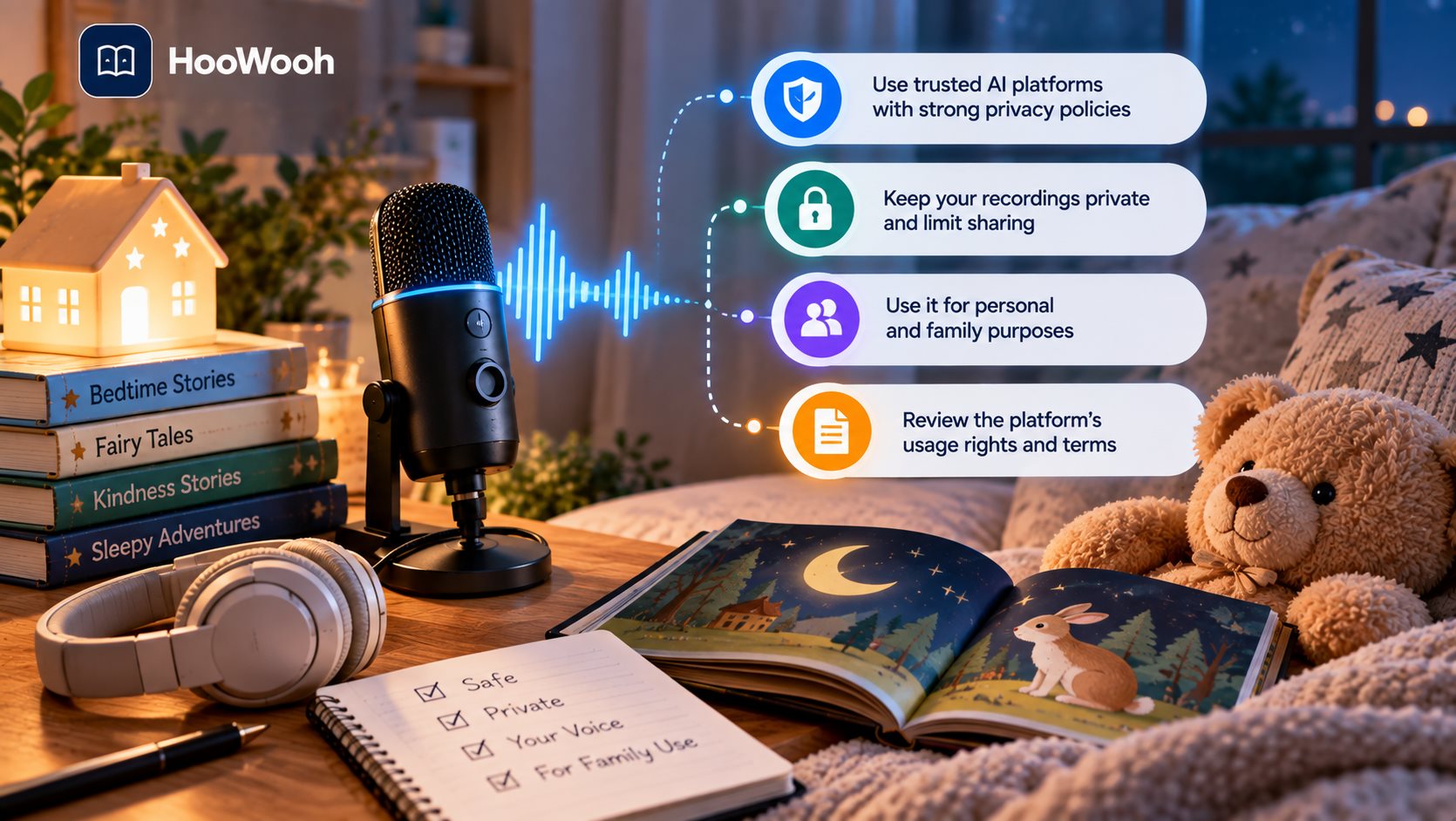
Using your own authorised voice can be a sensible way to personalise story narration, but voice privacy still matters. Read how the platform handles recordings, custom voices, account access, and deletion before uploading personal audio.
Do not assume a child's voice needs to be cloned just because the story is personalised for them. A parent can create Bedtime Stories in Your Own Voice without collecting the child's voice data. Personalisation can come from story choice, names, themes, and the narrator.
Hoowooh says custom voices are private by default and are created with the speaker's consent. Its About Hoowooh page explains the service's consent-first approach to custom voices.
Bedtime Stories in Your Own Voice With Hoowooh
Hoowooh is built around turning books and supported documents into cinematic audiobook experiences. For families, one useful part of that system is the ability to create a consent-based custom voice and use it for narration.
The current Hoowooh workflow allows users to upload an EPUB or PDF, scan supported printed pages, choose a narration style and voice, and generate audio. Its scenario-based narration is designed to change tone and pacing with the content rather than simply reading every line in the same flat style.
Parents interested in the wider book-to-audio process can explore the Hoowooh AI Audiobook Generator. For practical questions about custom voices, supported content, privacy, and conversion, the Hoowooh Help Center provides product-specific guidance.
A Simple Bedtime Story Routine With Personal Audio
Technology works best when it fits into a simple routine rather than making bedtime more complicated. Decide in advance when the audio will be used and keep the steps predictable for the child.
- Choose one suitable story before the bedtime routine starts.
- Use the authorised parent or family voice the child expects to hear.
- Keep the room and device volume comfortable and avoid unnecessary screen time.
- Let the child listen while following the usual bedtime steps.
- Save favourite stories for repeat nights and rotate them when the child wants something new.
Frequently asked questions
Can AI read bedtime stories in my own voice? Yes. With an authorised custom AI voice, supported systems can generate new story narration that resembles your voice. The quality depends on the recording, model, text, and narration settings. Review the result before using it at bedtime.
How much audio do I need to create my own bedtime-story voice? Requirements vary by service. Hoowooh currently asks for roughly 40–50 minutes of clear audio for its custom voice process. A clean recording with one speaker is important because background noise and overlapping voices can reduce quality.
Can both parents use their voices for bedtime stories? Yes, if the service supports separate custom voices and each parent agrees to have their voice cloned. Keep each person's consent and voice model separate rather than assuming one family member can approve another person's voice.
Can I use my child's favourite book for an AI bedtime story? Use books and text you own or are authorised to convert under the platform's rules and applicable rights. Owning a physical or digital copy does not automatically give permission to publish or distribute a new audiobook version.
Are AI bedtime stories meant to replace parents reading aloud? No. Personal audio is best treated as another storytelling option. Reading together allows real-time conversation and connection that generated audio cannot reproduce. A custom voice is especially useful when a parent cannot be present or wants prepared stories for busy nights.
Conclusion
Bedtime Stories in Your Own Voice can make story time feel more familiar when a parent cannot be there in person. The most useful approach is simple: choose suitable content, use an authorised voice, review the narration, protect voice privacy, and treat personal audio as support for the bedtime routine rather than a replacement for shared reading.
With Hoowooh, families can explore consent-based custom voices alongside book-to-audio narration. If you want to turn authorised stories into personal listening experiences, explore Hoowooh and discover a new way to keep familiar voices close to the stories your family loves.