How AI Audiobook Generators Work: From Book to Natural-Sounding Audio

If you are wondering How AI Audiobook Generators Work, the process is more than making a computer read text aloud. Modern systems extract a book’s words, organize long content, apply an AI voice, generate speech, and prepare listenable audio. More advanced tools can also adjust pacing, tone, and narration style.
What Is an AI Audiobook Generator?
An AI audiobook generator is software that turns written content into spoken audio with artificial intelligence. The source may be an ebook, PDF, text file, or, on platforms that support scanning, pages from a printed book. The goal is to create a continuous listening experience instead of asking someone to record every line in a studio.
The technology usually combines document processing with text-to-speech, language analysis, and audio production. A basic tool may simply read the words in order. A more advanced system can use context to make narration feel less flat by changing pace, emphasis, pauses, or delivery style. This difference matters because an audiobook is long-form listening. Small speech problems that seem minor in a short clip can become distracting across several hours.
Hoowooh takes this idea toward scenario-based narration. Its site describes modes for story, dialogue, explainer, and simple reading, along with expressive voice choices. Readers who want to see the product flow can explore Hoowooh’s AI audiobook experience.
How AI Audiobook Generators Work Step by Step
To understand How AI Audiobook Generators Work, it helps to follow the content from the moment a book enters the system to the moment the listener presses play. Exact methods differ between platforms, but the main workflow usually follows the same broad stages.
1. The Book or Document Enters the System
The process starts with a source. For a digital book, the user may upload EPUB, PDF, or TXT. The system then reads the file and identifies the text that needs narration. Clean ebook files are usually easier to process because the words already exist as selectable text.
Scanned documents are different. A scanned PDF may contain pictures of pages rather than actual digital text. In that case, OCR, or optical character recognition, can identify letters and words from the page image. The quality of the scan matters. Shadows, curved pages, unusual layouts, tiny print, or blurry photos can create recognition errors that later become narration errors.
2. The Text Is Cleaned and Structured
Raw extracted text is not automatically ready for speech synthesis. A book may contain page numbers, headers, footers, chapter titles, footnotes, repeated navigation text, tables, or formatting marks. The system needs to decide what should be spoken and how different sections relate to one another.
Structure also helps create a better listening experience. Chapter boundaries can become audio sections, while punctuation gives useful clues about pauses and sentence endings. Dialogue marks may signal a change in delivery. Good preprocessing reduces the chance that a listener hears unwanted page furniture or awkward breaks.
3. Long Books Are Divided Into Manageable Sections
A full novel can contain tens of thousands of words, so long-form audiobook generation is rarely treated like one short voice prompt. The content can be divided into chapters, passages, or smaller processing units. This makes generation easier to manage and helps a system preserve progress if one section needs to be generated again.
However, splitting a book creates another challenge: consistency. The narrator should not suddenly change speed, volume, accent, or energy between sections. A well-designed workflow therefore needs to keep the selected voice and narration settings stable while still responding to the content of each passage.
4. The User Chooses a Voice and Narration Style
Next comes one of the most noticeable choices: the AI voice. A clear, calm voice may suit study material, while fiction may benefit from a warmer or more dramatic delivery. The best choice depends on the book, the listener, and the purpose of the audio.
Some systems also offer a custom voice. Voice cloning uses recordings of a speaker to create a synthetic voice model that can read new text. Consent is essential here. A person’s voice is personal, so responsible use means cloning only a voice that the speaker has clearly allowed you to use. Hoowooh states that its custom voice feature is consent-based and private by default.
5. AI Converts the Text Into Speech
At the core of the workflow is text-to-speech technology. Modern speech models learn patterns connecting written language with spoken sound. When given a sentence, the model predicts how the words should sound and generates an audio waveform or an intermediate representation that becomes audio.
6. Pacing, Pauses, and Expression Shape the Performance
This is where AI narration can begin to feel different from a simple screen reader. A flat voice may technically pronounce every word correctly but still be tiring to hear. Natural listening depends on timing. Pauses need to arrive in sensible places, important words need suitable emphasis, and sentences need a rhythm that matches their meaning.
7. Audio Sections Are Assembled Into the Audiobook
Once speech has been generated, the separate sections need to become a practical audiobook. The system may organize chapters, normalize audio levels, store playback information, and prepare a streamable or downloadable file. This stage turns many generated speech segments into something a listener can use from beginning to end.
8. The Finished Audio Should Be Reviewed
Automation does not remove the need for quality control. Proper names, fictional terms, technical vocabulary, OCR mistakes, unusual punctuation, and dialogue can all create unexpected results. A short proof-listen can catch problems before someone commits to hours of listening or publishes the audio for an audience.
Useful checks include:
Pronunciation: names, places, acronyms, technical terms, and invented words should sound correct.
Pacing and pauses: sentences should not run together or stop in strange places.
Consistency: the chosen voice, volume, and delivery should remain steady across chapters.
Source accuracy: missing lines or strange words may point to a file-extraction or OCR problem.
How Does AI Know How a Book Should Sound?
An AI system does not “understand” a book in the same human sense as an actor or narrator. Instead, it detects patterns in language and uses context to predict suitable speech. Punctuation, sentence length, word choice, dialogue, and nearby sentences can all provide clues. Product settings can add another layer by telling the system to use a story, explainer, simple, or more expressive style.
Can AI Audiobook Generators Understand Emotion?
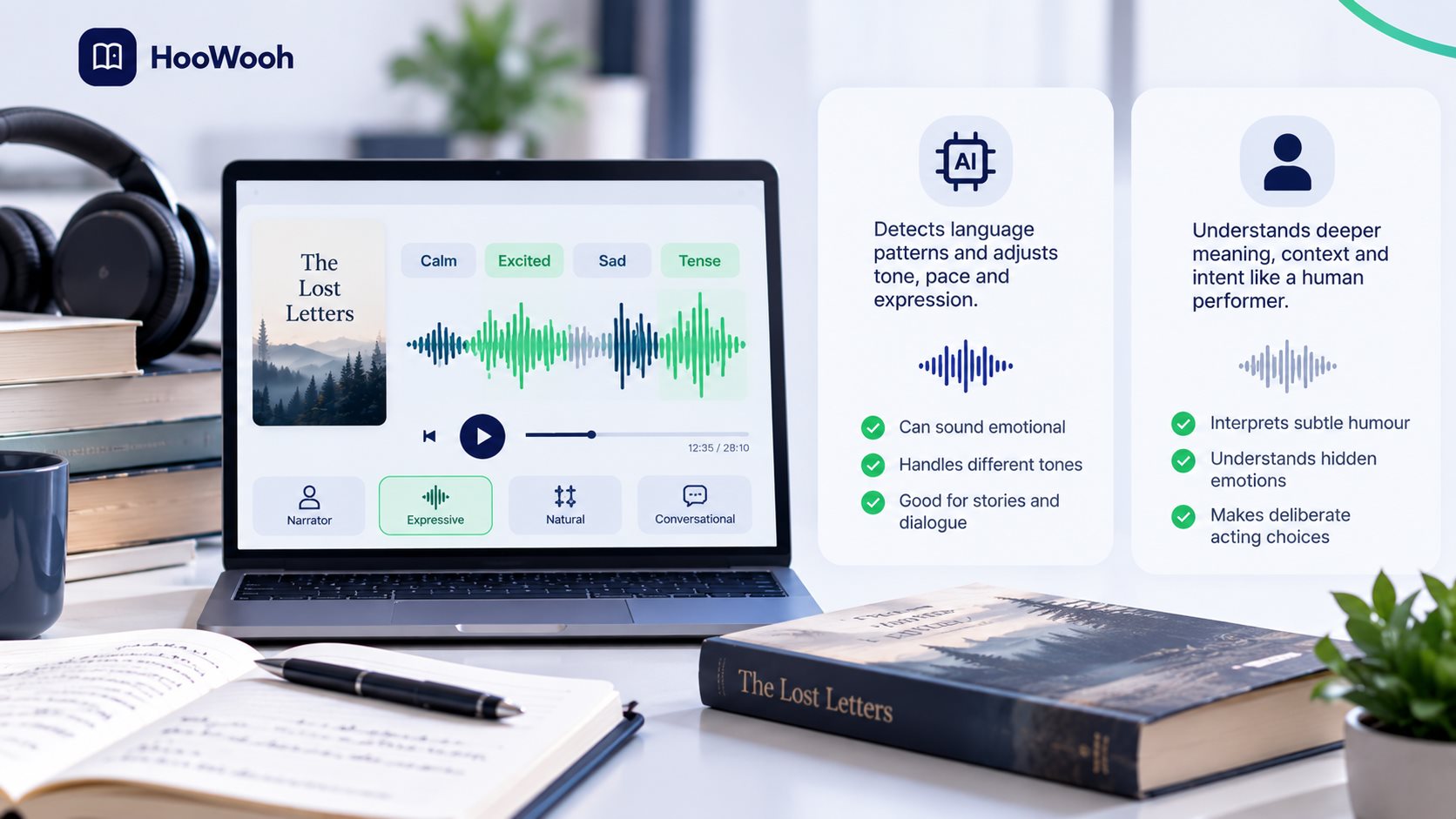
Modern AI audiobook generators can produce speech that sounds emotional, but it is better to describe this as context-aware expression rather than human emotional understanding. The system can detect language patterns associated with excitement, sadness, tension, questions, dialogue, or explanation and adjust the delivery when the model and product support it.
There are limits. A subtle joke, unreliable narrator, hidden grief, or deliberately ambiguous sentence may be interpreted differently by a human performer. Human narrators can discuss intent with an author or director and make deliberate acting choices. AI can be expressive, but users should still listen to important scenes and decide whether the performance matches the meaning they want.
Can AI Use Different Voices for Different Characters?
Character handling depends on the platform. Some tools focus on one narrator voice, while others can support dialogue-oriented modes or multiple voices. The technical challenge is not simply generating two voices. The system must correctly identify who is speaking and keep each character consistent across the book.
What Happens When You Upload a 300-Page Book?
A long book increases the importance of structure, reliability, and consistency. Instead of producing hours of audio in one uninterrupted action, a platform can process the book in smaller sections. Chapters provide natural boundaries, while smaller internal chunks can make generation easier to retry when something goes wrong.
Context: each section needs enough surrounding information for sensible delivery.
Continuity: voice characteristics and narration settings should remain stable from start to finish.
Recovery: one failed section should not force the entire book to start again.
Navigation: chapter structure should remain useful when the listener returns later.
Processing time also varies. Book length, file quality, narration settings, system demand, and the amount of audio processing can all affect how quickly a result is ready. Therefore, “How long does it take?” rarely has one universal answer.
AI Audiobook Generator vs Text-to-Speech: What Is the Difference?
The terms overlap, but they are not always used in the same way. Text-to-speech is the core technology that converts written language into spoken sound. An audiobook generator builds a longer workflow around that ability. It may import books, preserve chapters, manage long-form consistency, apply narration styles, process scans, and prepare files for listening.
AI Audiobook Generators vs Human Narrators
AI and human narration solve some of the same problems, but they do not create audio in the same way. AI can make conversion faster and more accessible for personal documents, study material, backlist titles, experiments, or projects that cannot support a traditional recording workflow. It also makes it easy to test different voices before generating a full book.
A human narrator, however, brings deliberate interpretation. A skilled performer can discuss character motivation, subtext, humour, pronunciation, and dramatic intent. That can be especially valuable in performance-heavy fiction or a commercial production where narration itself is a major creative element.
Purpose: personal listening and study have different needs from a commercial fiction release.
Performance needs: complex character acting may benefit from close human direction.
Time and budget: AI can reduce the recording workflow, while professional narration includes human performance and production work.
Control and review: whichever route you use, the final audio should be checked before publication or important use.
Why Are Authors and Readers Using AI Audiobook Generators?
The appeal is straightforward: audio can fit into moments when reading a page cannot. Students can listen during a commute. Readers can turn a compatible digital file into something they can hear while walking or doing routine tasks. Authors can test how a manuscript sounds aloud without arranging a full recording session.
What Can Go Wrong With AI-Generated Audiobooks?
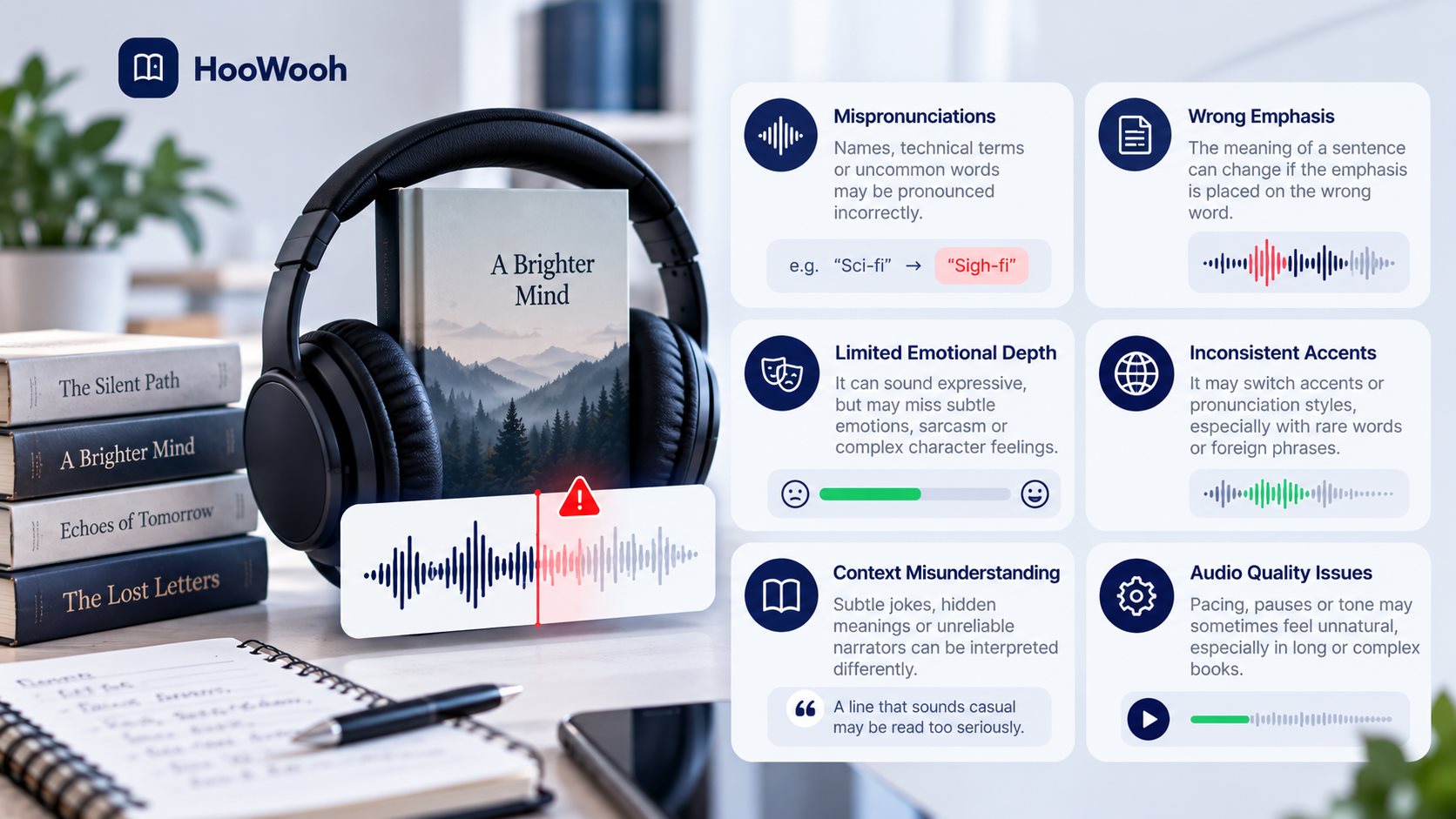
The most common problems are often small on their own but noticeable over time. A name may be mispronounced every time it appears. A pause may land in the middle of a thought. OCR may turn one printed word into another. A voice can sound convincing in narration but weak in emotional dialogue. Long chapters can also expose consistency problems that short demos hide.
Hoowooh’s Help Center also groups guidance around conversions, scanning, voices, playback, and failed conversions, which is useful when a source file or scan needs attention.
Are AI Audiobook Generators Ethical and Legal to Use?
The technology can be useful without giving users unlimited rights over books or voices. Copyright and permission still matter. Owning a physical copy of a book does not automatically mean you own the rights to distribute a new audiobook version. Personal use, publication, and commercial distribution can involve different legal questions depending on the work and jurisdiction.
The same care applies to voice cloning. Do not clone a real person’s voice simply because recordings are available online. Clear permission should come first. Platforms should also be transparent about how voice data is stored and who can access the resulting model. Hoowooh states that consent is central to its custom voice feature and that custom voices are private by default.
For more on the brand’s approach to consent, privacy, and narration quality, read About Hoowooh.
How Hoowooh Turns Books Into Audiobooks
Hoowooh is designed around a simple path from book to listening. According to its current site, users can upload EPUB, PDF, or TXT files or scan printed pages. They then choose a narration style and voice, generate the audio, and can listen or download MP3 audio for offline use. The platform also describes scenario-based narration that can shift tone, pacing, and emotion rather than relying only on flat reading.
Its approach is especially relevant to people asking How AI Audiobook Generators Work because it brings several parts of the process into one experience: file input, scanning with OCR, expressive voice selection, optional consent-based voice cloning, generation, and playback. The value is not one isolated AI feature; it is the workflow that connects written content to usable long-form audio.
FAQs
How do AI audiobook generators work?
AI audiobook generators extract or recognize written text, organize it into sections, apply a selected voice and narration settings, use speech synthesis to create spoken audio, and assemble the results for listening. More advanced systems may also use context to adjust pacing, pauses, emphasis, and expressive delivery.
Can AI turn an entire book into an audiobook?
Yes, long-form systems can process full books, although supported file types, book length, generation limits, and processing methods vary by platform. Long books are often easier to manage when the system preserves chapters and processes content in smaller sections while maintaining the same voice settings.
Do AI-generated audiobooks sound natural?
They can sound natural, especially when the model handles rhythm, pronunciation, pauses, and expression well. Quality still varies by voice, language, content, and platform. A realistic voice alone does not guarantee a strong audiobook, so listening to a sample and checking difficult passages is important.
Can AI audiobook generators use different voices for characters?
Some can support multiple voices or dialogue-focused narration, while others use one narrator throughout. If character separation matters, test scenes with several speakers and check whether the system keeps each voice consistent and assigns dialogue correctly.
How long does AI audiobook generation take?
There is no single generation time for every book. Length, source-file quality, scan quality, voice settings, processing demand, and the platform’s workflow can all affect the result. A short document may be quick, while a full novel naturally requires more processing.
Conclusion
Understanding How AI Audiobook Generators Work makes it easier to judge the finished audio. The process starts with clean text, then moves through structure, AI voice selection, speech generation, expression, assembly, and quality checks. The strongest results depend on more than a realistic voice: pacing, context, consistency, source accuracy, consent, and human review all matter.
If you want to experience that workflow yourself, visit Hoowooh and explore how a digital file or scanned book can become a more expressive, listenable audiobook.
Meta Title:
How AI Audiobook Generators Work - Hoowooh
Meta Description:
Learn How AI Audiobook Generators Work, from text extraction and AI narration to expressive voices, quality checks, and finished audio.
Meta Tags:
How AI Audiobook Generators Work, AI audiobook generator, AI narration, text-to-speech, voice cloning, audiobook generation, AI voice, audiobook creation, expressive narration, AI-generated audiobooks, natural-sounding AI voices, audiobook text-to-speech
Excerpt:
Wondering How AI Audiobook Generators Work? This guide follows a book from upload to finished audio and explains text processing, AI voice selection, expressive narration, long-form generation, quality checks, and where human review still matters.