Best AI Audiobook Generators 2026 - What to Look For

Best AI Audiobook Generators 2026 should do more than make a short voice sample sound realistic. A strong tool must stay consistent across chapters, handle dialogue, support useful book formats, correct mistakes, and export reliable audio. This guide explains what matters before you turn a full book into an AI-narrated audiobook.
What Is an AI Audiobook Generator?
An AI audiobook generator turns written content into spoken audio using synthetic voices. At a basic level, it performs text-to-speech. More advanced systems can also analyse dialogue, assign character voices, adjust pacing, and change delivery for different scenes.
The right tool depends on the book. A novel with ten recurring characters has different needs from a short business guide. That is why the best choice should be based on the complete workflow rather than one impressive voice demo.
How AI Audiobook Generators Work
The process usually begins with a digital book or text file. The system extracts the words, separates sections, and prepares them for speech generation. If the tool supports more advanced AI audiobook narration, it may also analyse dialogue, speakers, punctuation, and scene context before generating audio.
The speech model then creates the narrator voice. Some tools use one voice for everything. Others support multi-character narration, allowing dialogue to sound different from the main narration. The generated sections are then assembled into chapters or audio files.
What Makes the Best AI Audiobook Generator in 2026?
The best AI audiobook generator is the one that remains useful after the first few minutes. Audiobooks can run for many hours, so long-form reliability matters more than a polished sample. Look at how the system behaves with real chapters, dialogue, difficult names, and repeated characters.
- Natural narration that stays comfortable across long listening sessions.
- Long-form voice consistency so the narrator and recurring characters remain stable.
- Character detection and multi-character narration for dialogue-heavy books.
- Pronunciation control or an easy way to correct names and specialist terms.
- Useful file support for the formats you actually work with.
- Editing or selective regeneration so one mistake does not require a full chapter rebuild.
- Reliable export options for listening, review, and offline use.
Natural Narration
Natural AI voices should sound clear without drawing attention away from the book. Listen for repeated rhythm, strange pauses, sudden emphasis, and sentences that become rushed near the end. A voice can sound human for twenty seconds and still become tiring over several hours.
Long-Form Voice Consistency
Long-form narration is one of the hardest tests. The narrator should not slowly change in pitch, pace, or personality as the book continues. If separate chapters are generated at different times, they should still feel like parts of the same production.
Character Detection and Multi-Character Voices
Fiction often contains rapid dialogue, dialogue tags, inner thoughts, and scenes with several speakers. An advanced audiobook maker may identify those changes and assign different character voices.
Automatic detection can save time, but it should still be checked. A system can misread who is speaking, especially when the author leaves the speaker implied. The ability to review or correct assignments is therefore valuable.
Emotional and Scenario-Based Narration
Emotional narration can change energy, pace, and emphasis according to the scene. A calm explanation should not sound like an argument, and a tense moment should not use the same rhythm as a quiet reflection.
Scenario-based narration can make this more controlled by matching delivery to the type of passage. The goal is not to make every sentence dramatic. It is to keep the narration appropriate to the text.
Pronunciation Control
Names, invented places, abbreviations, scientific terms, and foreign words can expose weaknesses in an AI narrator. A good workflow lets you test difficult words before generating hours of audio.
File Support and Export
Check whether the tool accepts the source format you already have. EPUB to audiobook workflows are useful for ebooks, while PDF to audiobook support matters for reports and study material. TXT or pasted text can be enough for simple manuscripts.
Output matters too. A finished audiobook should be easy to review and play. Downloadable audio also makes an offline audiobook workflow possible after generation.
Why Long-Form Consistency Matters More Than a Voice Demo
Voice demos are designed to show a system at its best. They are short, clean, and usually free from complex dialogue. A full book is different. It contains chapter breaks, unusual names, long conversations, emotional changes, and passages that may be harder to interpret.
A useful test should therefore include several pages rather than one sentence. Listen for narrator drift, character changes, repeated intonation, skipped words, and pacing that becomes unnatural during longer paragraphs.
Can AI Audiobook Generators Detect Characters Automatically?
Some advanced systems can analyse text for speaker changes and dialogue. They may use dialogue tags, paragraph structure, character names, and surrounding context to decide who is speaking.
This can speed up multi-character narration, but it is not perfect. A sentence such as “I knew you would come,” followed by no dialogue tag may require wider context. Human review remains useful when the speaker is ambiguous.
The strongest workflow combines automation with control. Let the system identify likely speakers, then make it easy to correct the few places where the interpretation is wrong.
Can You Fix One Bad Line Without Regenerating the Whole Book?
This is an important practical feature. A chapter may be excellent except for one mispronounced name, one rushed sentence, or one line assigned to the wrong character. Regenerating everything wastes time and can also change audio that was already correct.
Selective regeneration lets the creator edit a small section and replace only that audio. It is especially useful for long books because minor errors are almost inevitable when thousands of sentences are processed.
When comparing tools, check how corrections work. Editing should be part of the audiobook workflow, not an afterthought.
What File Types Should an AI Audiobook Generator Support?
There is no single required format, but the tool should match the material you use. EPUB is common for ebooks. PDF is useful for digital books and documents. TXT works well for clean text. Scanned pages need OCR before speech can be generated.
File support is only useful when the reading order is correct. PDFs with columns, headers, footnotes, and tables can be harder to process than a clean ebook. Test complex pages before converting a full document.
Hoowooh supports common digital book and text workflows and can use OCR for scanned printed material, making it possible to move from a physical or digital source toward generated audio.
AI Audiobook Generator vs Basic Text-to-Speech
Basic TTS focuses on converting text into understandable speech. That may be enough for notes, drafts, or private listening. An AI audiobook generator is more useful when the project needs chapters, expressive delivery, character handling, and long-form consistency.
Local vs Cloud AI Audiobook Generators
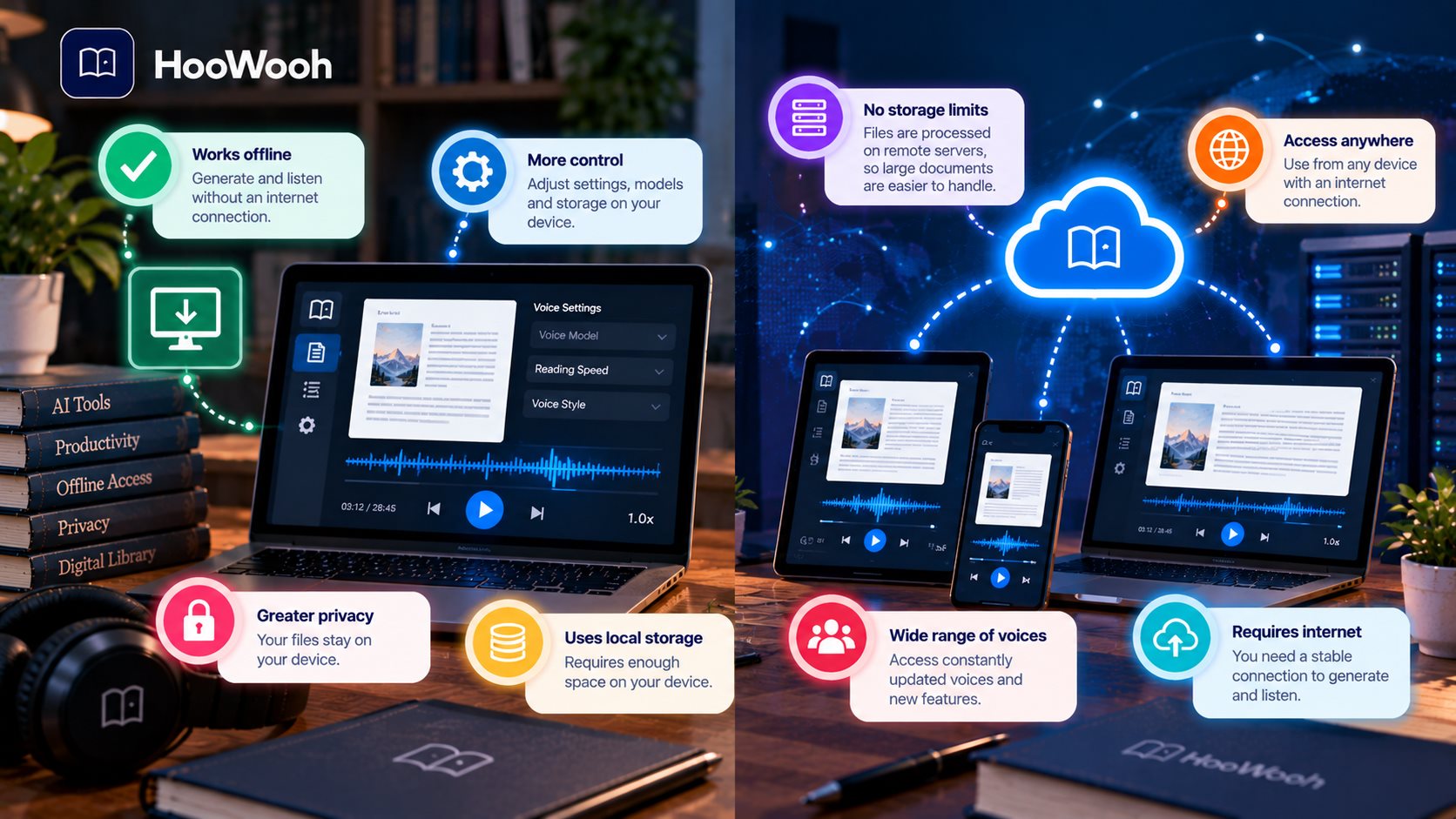
Local AI runs models on your own computer. Cloud generation sends the work to a remote service. Both approaches can produce useful audio, but they solve different priorities.
- Local generation can provide more control over files and models, but setup may be technical.
- Cloud tools are usually easier to start because model installation and hardware management are handled for you.
- Local systems may need a capable computer, especially for faster generation or larger speech models.
- Cloud services may use subscriptions, credits, or generation limits depending on the plan.
- Privacy, convenience, cost, and technical skill should all be considered before choosing either approach.
Do You Need a Powerful Computer for AI Audiobook Generation?
Not always. Cloud-based tools perform most of the processing on remote servers, so the user's device mainly handles uploading, settings, and playback. Local AI is different because the computer must run the speech model itself.
Are Free AI Audiobook Generators Really Free?
Free options can be useful for testing, short projects, or local experiments, but “free” does not always mean unlimited. A service may restrict monthly characters, voice choices, exports, or commercial use. A local tool may have no subscription while still requiring suitable hardware and setup time.
Before converting a full book, estimate its length and check what the free tier actually covers. Also review whether the output can be downloaded and whether the usage terms match your project.
Best AI Audiobook Features for Fiction
Fiction benefits most from character consistency and scene-aware delivery. Dialogue should be easy to follow, but characters do not need exaggerated voices. Small differences in pace, tone, and vocal identity can be enough.
Emotional narration should also remain controlled. A thriller may need tension, while a quiet literary scene may need restraint. The generator should adapt rather than applying the same dramatic style to every chapter.
Best AI Audiobook Features for Non-Fiction
Non-fiction usually places clarity first. A stable narrator, accurate pronunciation, clean chapter structure, and comfortable pacing are often more important than a large cast of voices.
What About Textbooks and Scanned Books?
Textbooks create extra challenges because information may be spread across prose, diagrams, formulas, tables, and captions. Audio can handle the main text, but visual material should still be checked in the original source.
For printed books, OCR converts page images into text before narration. Poor scans can create wrong words or broken reading order, so quality control should happen before a long generation job begins.
Hoowooh can support scanned-page workflows with OCR and then turn the extracted text into narration, which can be useful when the source is not already a clean digital book.
Do You Need Voice Cloning for an AI Audiobook?
No. Voice cloning is optional. Many creators can use built-in natural AI voices and still produce a complete audiobook. Cloning is useful when an author or authorised speaker wants a custom vocal identity.
Voice cloning also does not automatically create good audiobook narration. It answers the question of whose voice is being reproduced. Pacing, character detection, emotion, and long-form consistency still depend on the narration system and settings.
Only use a cloned voice when you have the appropriate permission to create and use it.
What Can Go Wrong With AI Audiobook Generation?
AI audiobook generation can save time, but it still needs review. Problems may include skipped words, wrong speaker assignments, rushed lines, unusual pauses, mispronounced names, inconsistent character voices, or sections assembled in the wrong order.
The safest workflow is to test early, review chapters, and correct errors before producing the final files.
How to Test an AI Audiobook Generator Before Converting a Full Book
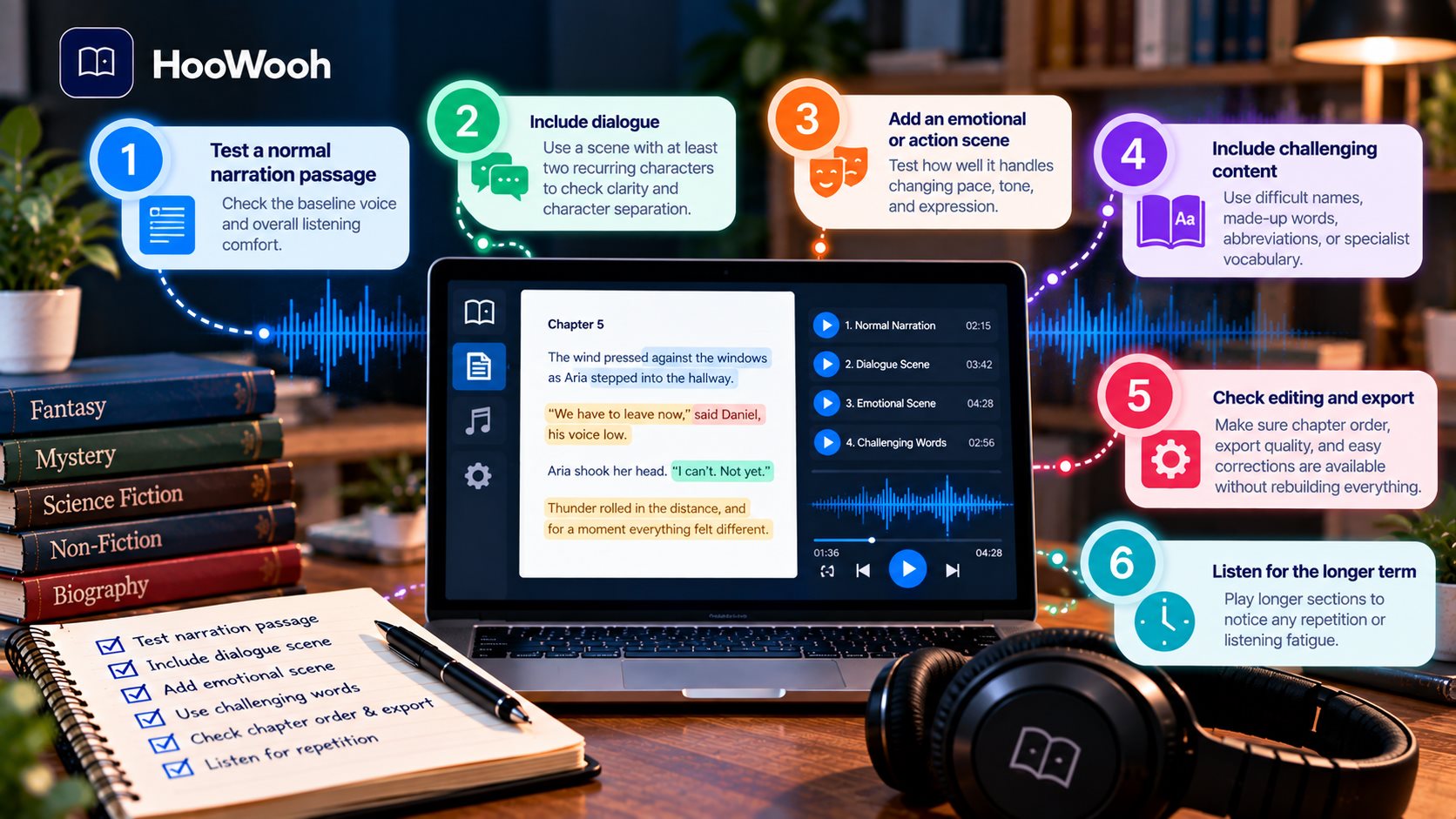
A realistic test should contain the parts of the book that are most likely to challenge the system. Do not choose only a clean descriptive paragraph.
- Test a normal narration passage to judge baseline voice comfort.
- Include dialogue between at least two recurring characters.
- Add a scene with emotion or a major change in pacing.
- Include difficult names, invented words, abbreviations, or specialist vocabulary.
- Check chapter order, export quality, and whether corrections can be made without rebuilding everything.
- Listen long enough to notice repetition or fatigue, not just the first impressive minute.
How to Choose the Best AI Audiobook Generator for Your Book
Start with the book rather than the tool. Count how much dialogue it contains, whether characters recur across many chapters, and whether the text includes specialist vocabulary or unusual formatting. Then identify the features that solve those specific problems.
Next, test the complete workflow. Upload a representative chapter, choose the voice, generate it, make one correction, export the audio, and listen on the device you normally use. A tool that is easy at every step is more valuable than one with a better demo but a difficult production process.
Finally, consider rights, privacy, cost, and the amount of human review you are willing to do. AI can automate narration, but a finished audiobook still benefits from careful listening.
Where Hoowooh Fits Into AI Audiobook Generation
Hoowooh is designed around turning supported books and documents into expressive audio. Its workflow goes beyond a simple read-aloud voice by supporting scenario-based narration, character-aware delivery, and long-form audiobook creation.
Users can work with supported digital files or scanned printed pages, choose suitable voices, generate narration, and save completed audio for listening. This makes Hoowooh relevant to readers and creators who want a guided book-to-audio workflow without building a local speech system from scratch.
For fiction, the value is in expressive narration and character handling. For non-fiction and study material, clear delivery and document conversion are more important. The same platform can serve different books by changing the narration approach rather than forcing one style onto every project.
Frequently asked questions
What is the best AI audiobook generator in 2026? There is no single best choice for every book. Compare long-form consistency, voice quality, character handling, pronunciation, editing, file support, export options, privacy, and cost. The best tool is the one that performs reliably with your actual material.
Can AI turn a whole book into an audiobook? Yes, an AI audiobook generator can process long-form text and create spoken audio, provided the tool supports the file and project length. Full books still need quality checks for pronunciation, dialogue, chapter order, and consistency.
Can AI audiobook generators use different voices for characters? Some can. Multi-character narration may identify dialogue and assign different character voices. The feature is most useful when the same characters keep consistent voices across the full book and speaker assignments can be corrected when needed.
Can I clone my own voice for an audiobook? Yes, if the platform supports voice cloning and you have the right to use the recorded voice. A cloned voice can become the narrator, but good audiobook results still depend on pacing, pronunciation, emotion, and long-form stability.
Are there free AI audiobook generators? Yes, but free options may have limits on usage, voices, exports, or project length. Local AI can reduce subscription dependence but may require stronger hardware and more setup. Test the real workflow before choosing based on price alone.
Conclusion
Best AI Audiobook Generators 2026 should be judged by what happens across an entire book, not by one realistic voice sample. Long-form consistency, character handling, pronunciation, editing, file support, export reliability, privacy, and ease of use all affect the final listening experience.
Choose a generator that fits your book type and test it with real dialogue, difficult words, and a complete chapter before committing to a full conversion. Hoowooh offers a focused book-to-audio workflow with expressive and scenario-based narration for readers and creators who want to turn supported material into listenable audio. Start with a short test, review the result carefully, and build from there.