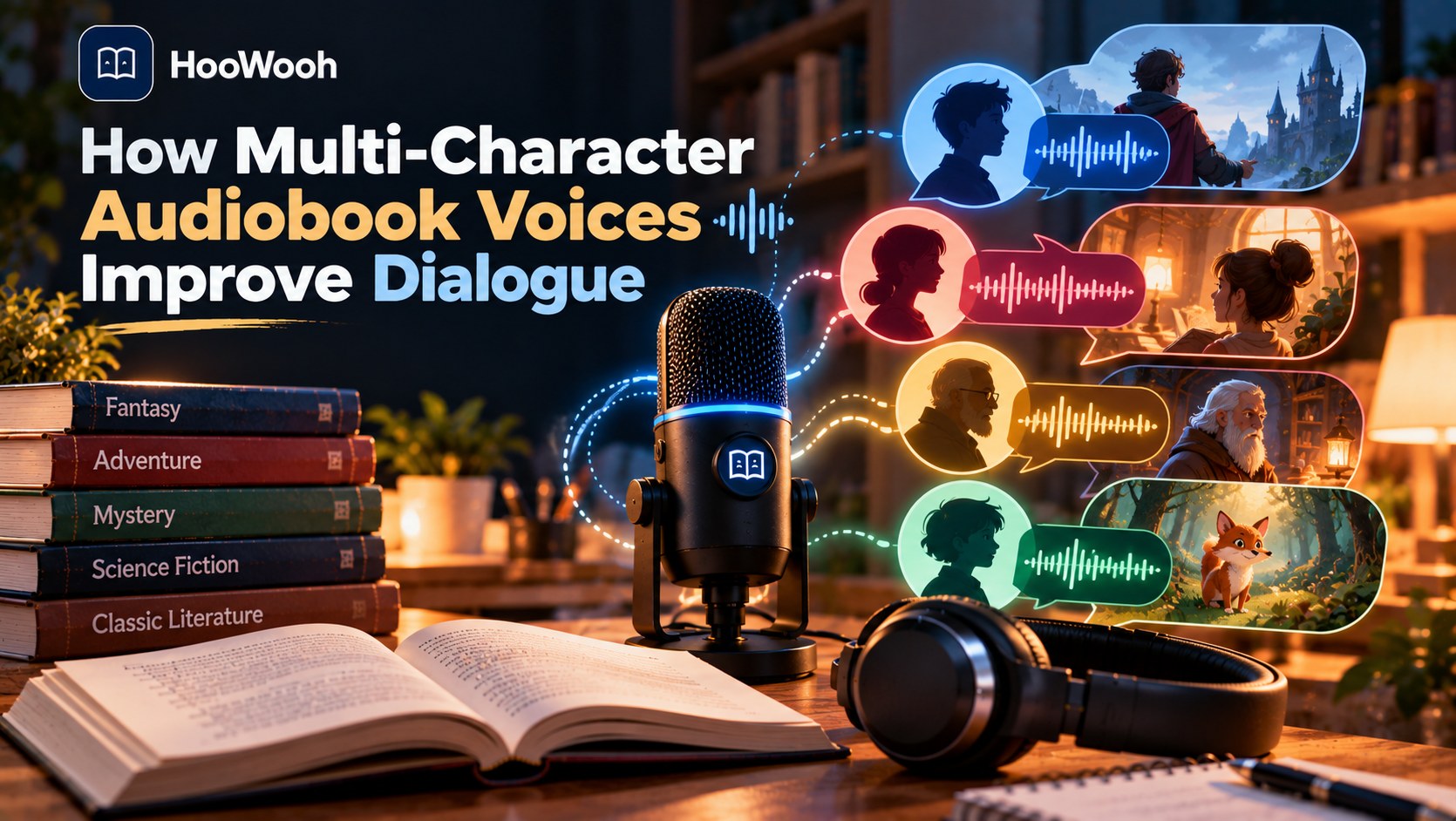
How Multi-Character Audiobook Voices Improve Dialogue comes down to clarity, consistency, and emotion. Distinct voices can help listeners recognise speakers without checking every dialogue tag. When those voices stay natural and consistent, conversations become easier to follow while each character keeps a clear identity throughout the audiobook.
What Are Multi-Character Audiobook Voices?
Multi-character audiobook voices give different characters recognisable vocal identities during narration. The distinction can come from one skilled narrator changing delivery, several human narrators, or AI voices assigned to different speakers. The goal is not simply to make every line sound different. It is to help the listener understand who is speaking.
In a traditional audiobook, a single narrator may change pitch, pace, accent, rhythm, or energy for each person. In an AI narration workflow, separate voice profiles can serve a similar purpose. A narrator voice may handle descriptive text while character voices handle dialogue.
This approach is especially useful in scenes with rapid exchanges. When several audiobook characters speak one after another, vocal separation can reduce the mental effort needed to track the conversation.
How Multi-Character Audiobook Voices Improve Dialogue
Dialogue works best when the listener can follow the conversation without stopping to decode it. Multi-character audiobook voices can create that separation through small, repeatable differences. The effect should support the words rather than compete with them.
They Make Speakers Easier to Identify
When two characters sound noticeably different, the listener can often recognise the speaker before hearing a dialogue tag. This is useful in long conversations, group scenes, and books with a large cast.
Good character identification does not require extreme accents or cartoon voices. A measured older character and a quick, energetic younger character may already sound distinct enough.
They Reduce Dialogue Confusion
Written fiction often uses tags such as “he said” and “she replied.” Audio listeners cannot look back at the page as quickly as readers can. If the vocal identity changes clearly with the speaker, audiobook dialogue can remain understandable even during fast exchanges.
This matters most when the text contains several short lines in a row. The voice itself becomes an extra clue that supports the wording.
They Give Characters Stronger Vocal Identities
A consistent voice can become part of how a listener recognises a character. Pace, warmth, confidence, age impression, vocal weight, and speaking rhythm can all contribute. The character does not need a completely different accent to feel distinct.
Over time, listeners may associate a particular delivery with that character. When the voice returns later, it helps reconnect the listener with the role.
They Make Fast Conversations Easier to Follow
Arguments, group discussions, comedy, and action scenes can move quickly. If every line uses the same delivery, listeners may need extra concentration to remember who is talking. Carefully separated character voices can make those transitions clearer.
The key word is carefully. Too much contrast can become distracting. The voices should be different enough to guide the listener while still sounding as though they belong in the same audiobook.
They Can Add Emotion Without Losing Character Identity
A character should not sound emotionally flat simply because their voice needs to stay consistent. The same person may whisper in one scene, shout in another, and speak nervously later. Expressive narration changes the performance while preserving the core vocal identity.
This balance is important for natural dialogue. The listener should hear both who the character is and what the character feels.
How Does AI Know Which Character Is Speaking?
AI-based audiobook systems can analyse text structure, quotation marks, dialogue tags, names, and surrounding context to work out who is speaking. A clear sentence such as “Wait for me,” Anna said, provides an obvious cue. The system can connect Anna with an assigned voice.
Harder passages may not name the speaker on every line. In a two-person conversation, the text may alternate speakers for several paragraphs. Character identification then depends more heavily on context.
Ambiguous writing can still cause mistakes. If the source text does not make the speaker clear, an automated system may assign the wrong voice. That is why review remains important, especially in books with large casts or unusual dialogue formatting.
How Are Different Voices Assigned to Characters?
Once a character is identified, a narration system needs a stable voice assignment. Major characters may receive clearly separated voices, while minor characters can use subtler variations. The narrator voice should also remain distinct from spoken dialogue when that helps clarity.
Voice assignment works best when it considers the role rather than randomly changing sound. A calm mentor, nervous student, confident detective, and impatient rival can differ through pace and energy as well as pitch.
Hoowooh describes its audiobook experience as using character recognition and multi-voice narration. Its AI Audiobook Generator explains how its narration approach aims to match voices and delivery to the content.
- Pitch can separate voices, but large pitch changes are not always necessary.
- Pacing can make one character measured and another quick or impulsive.
- Rhythm and pauses can give each speaker a recognisable conversational pattern.
- Energy can distinguish calm, nervous, confident, tired, or excited characters.
- Accent or vocal texture can help when used consistently and appropriately.
How Do Audiobooks Keep Character Voices Consistent?
Character voice consistency is more important than simply creating an impressive voice once. A character introduced in chapter two may disappear for hours and return in chapter twenty. If the voice suddenly changes, the listener may wonder whether a new person has entered the scene.
Human narrators often keep reference samples or notes for important characters. Those references can capture pitch, accent, rhythm, and other details so the narrator can return to the same vocal identity later.
AI narration needs the same basic principle: a stable voice profile should stay linked to the same character across scenes. Consistency becomes even more important in long novels and book series where the listener builds strong associations between characters and voices.
What Makes Two Character Voices Sound Different?
Two characters do not need opposite voices. Small differences can be enough. One may speak slowly with longer pauses. Another may use short, quick phrases. A third may have a warmer tone or lower vocal weight.
Age, personality, setting, and relationship can influence the performance, but stereotypes should not replace character understanding. The goal is clear dialogue, not exaggerated imitation.
For major roles, voices need enough flexibility to handle many emotions. A voice that only works when a character is calm may become awkward during anger, fear, humour, or grief.
How Emotion Changes Dialogue Without Changing the Character
Imagine a character with a calm, low, deliberate voice. In a frightening scene, that person may speak faster and breathe more sharply. In a private conversation, the same voice may become softer. The emotional delivery changes, but the listener should still recognise the character.
This is where scenario-based narration becomes useful. Instead of treating every sentence as isolated text, the narration can respond to the mood and context of a scene.
Are Multiple Character Voices Always Better?
No. Listener preference matters. Some people enjoy strong character separation because it makes conversations vivid and easy to follow. Others prefer a single narrator who uses only subtle differences. A heavily voiced production can feel distracting to listeners who want a quieter reading style.
The book also matters. A dialogue-heavy fantasy novel with a large cast may gain more from character separation than a reflective memoir with little conversation. Even fiction does not automatically need a different voice for every minor role.
The best multi-character audiobook voices serve the text. If listeners notice the voice system more than the story, the production may be doing too much.
When Can Too Many Character Voices Become Distracting?
More voices can create clarity up to a point. Beyond that point, constant switching may make an audiobook feel busy. Very dramatic accents, extreme pitch shifts, or inconsistent performances can pull attention away from the words.
Large casts create another problem: listeners still have to remember who each voice belongs to. Giving twenty minor characters highly distinctive performances does not automatically make the plot easier to understand.
A sensible approach is to give the strongest identities to important recurring characters and use lighter distinctions where a role appears only briefly.
Single Narrator vs Multi-Character Narration
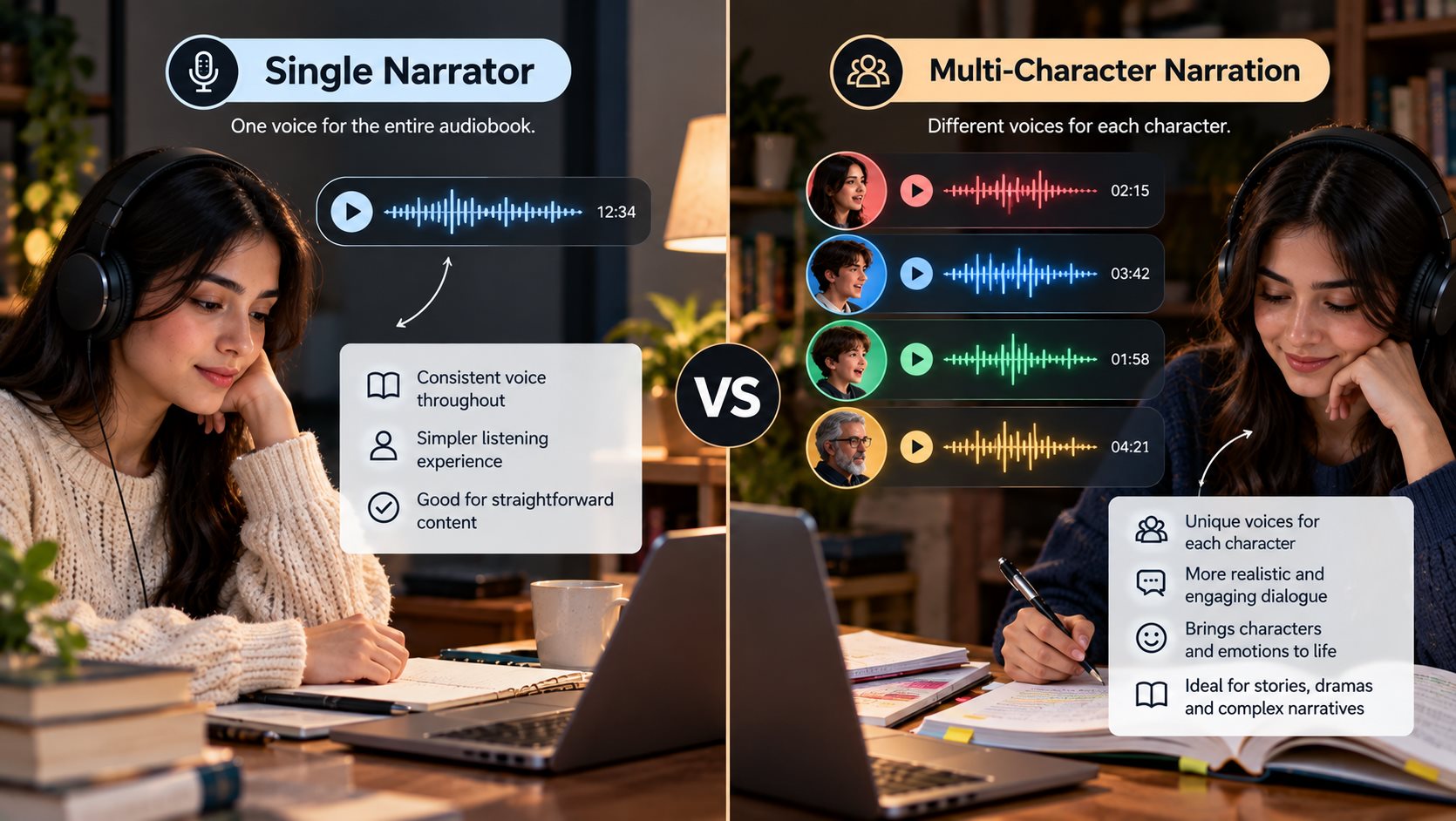
A single narrator can still create excellent character dialogue. Skilled narrators often use subtle vocal changes while keeping one overall storytelling style. This can make the audiobook feel unified and leave more room for the listener's imagination.
Multi-character narration creates stronger separation between speakers. That can help in dialogue-heavy scenes and ensemble stories. AI systems can also use separate voice profiles without requiring a completely separate human performer for every role.
Neither format is automatically superior for every listener. The right choice depends on the book, production style, and how much vocal distinction supports the story.
- Single-narrator performance keeps one overall storytelling voice and may use subtle character changes.
- Multi-character narration gives recurring speakers stronger vocal separation.
- Dual or duet narration can divide roles between two performers or voice groups.
- A full-cast audiobook may use many performers for individual roles.
- An audio drama may add heavier sound design, music, effects, and adapted dialogue.
Multi-Character Audiobook vs Full-Cast Audiobook
These terms are often mixed together, but they do not always describe the same production. A multi-character audiobook can still have one narrator or one AI system that assigns several character voices. A full-cast audiobook normally uses a wider group of performers for separate roles.
An audio drama goes further. It may adapt the source, add sound effects and music, reduce narration, and stage scenes more like radio theatre. A conventional audiobook usually stays closer to the written text.
This distinction matters because someone who wants clearer audiobook dialogue may not want a full cinematic production. Character separation can improve clarity without turning every chapter into a drama.
Which Books Benefit Most From Multi-Character Voices?
Dialogue-heavy fiction is the clearest use case. Fantasy, romance, mystery, thrillers, and ensemble stories often contain recurring characters who speak frequently. Recognisable voices can help listeners move through those conversations with less confusion.
Books that switch viewpoints may also benefit when the narration style makes those changes clear. However, voice choices should follow the actual structure of the book rather than forcing a cast system onto material that does not need one.
Non-fiction, essays, and textbooks often need a different approach. Clear narration may matter more than assigning character identities because the content is based on explanation rather than conversation.
How AI Can Handle Multi-Character Audiobook Dialogue
An AI audiobook workflow can combine several tasks: analyse the text, identify dialogue, connect lines with characters, assign voices, generate speech, and adjust delivery for context. Each stage affects the final result.
The system also needs continuity. If a character appears again after several chapters, the same voice profile should return. If the scene becomes emotional, the delivery can change without replacing that character's identity.
AI can make this process scalable, but automation does not remove the need for quality review. Ambiguous speaker tags, unusual formatting, rare names, or complex scenes can still create errors.
How to Review Multi-Character Audiobook Dialogue
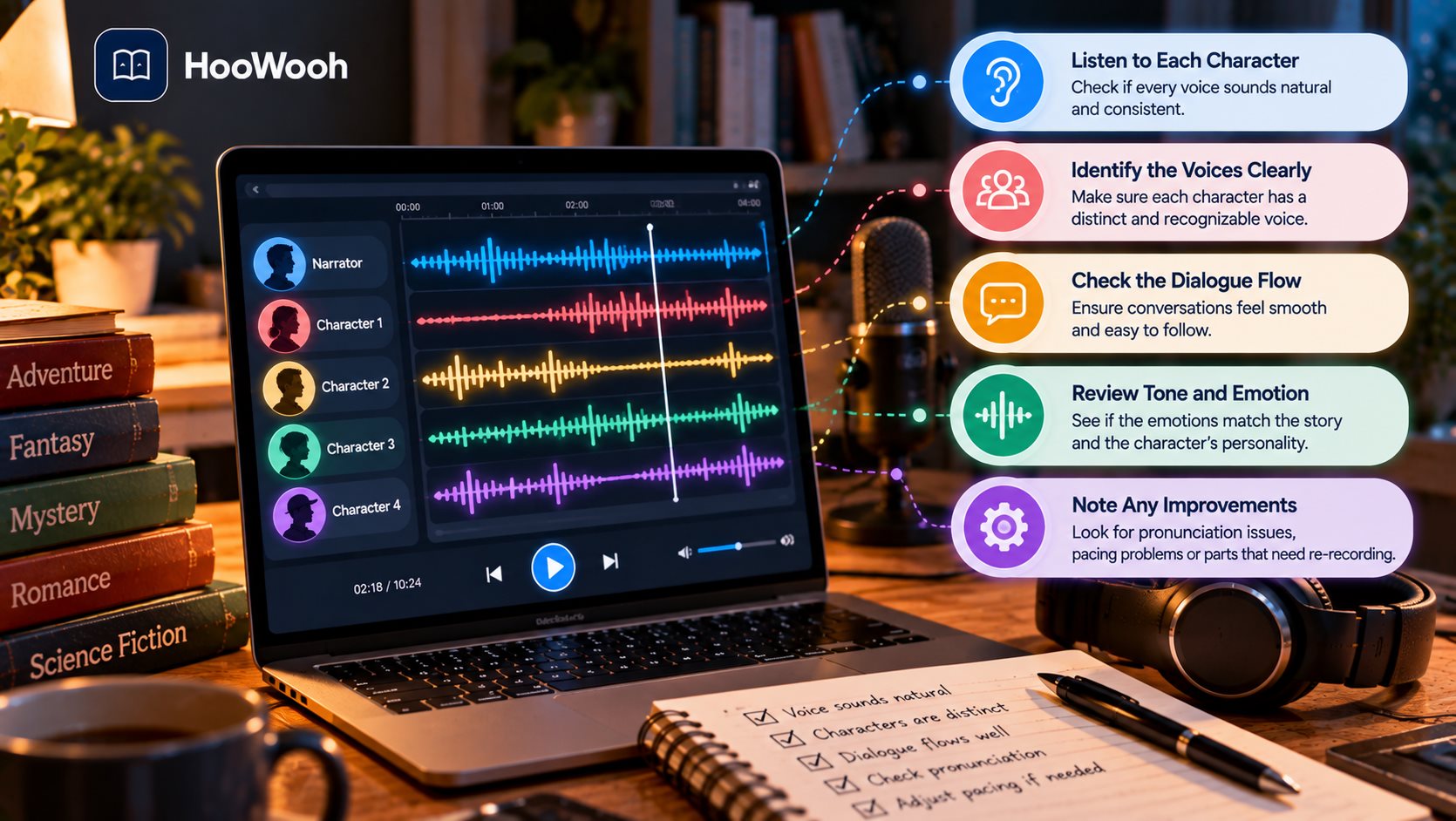
Quality checking should focus on the conversation rather than voice novelty. Ask whether you can follow the scene naturally. If you need to stop and work out who is speaking, the voice separation may not be doing its job.
Also listen for consistency. A recurring character should not suddenly gain a new accent or change age impression without a story reason. Emotional shifts should feel connected to the scene rather than random.
Finally, check whether the performance respects the pacing of the book. Dialogue needs room to breathe. Constant dramatic emphasis can make ordinary conversations sound unnatural.
- Check that recurring characters keep the same core voice across chapters.
- Make sure fast conversations remain easy to follow without extreme vocal changes.
- Listen for wrong speaker assignments in scenes with limited dialogue tags.
- Check that emotional delivery matches the scene while preserving character identity.
- Reduce unnecessary voice contrast if the performance starts distracting from the story.
Multi-Character Narration With Hoowooh
Hoowooh is designed to turn books and supported documents into more expressive audiobook experiences. Its product information describes character recognition, multi-voice narration, and scenario-based delivery as parts of the listening workflow.
For dialogue-heavy books, those features are relevant because the challenge is not simply reading quotation marks aloud. The narration needs to recognise who is speaking, keep recurring voices stable, and deliver the line in a way that fits the scene.
Frequently asked questions
Do different character voices make audiobooks easier to follow? They can. Clear vocal differences help listeners recognise speakers during fast or dialogue-heavy scenes. However, the voices should stay natural and consistent. Extreme differences can become distracting instead of improving clarity.
How does AI know which character is speaking in an audiobook? AI can analyse quotation marks, speaker tags, names, dialogue structure, and nearby context. Clear dialogue is easier to assign than passages where the author leaves the speaker unstated. Ambiguous scenes may still need review.
Can one narrator use different voices for every character? Yes. Human narrators often create different vocal identities through pitch, rhythm, accent, pace, and energy. One narrator does not need to sound like a completely different person for every role; subtle distinctions can be enough.
Are multi-character audiobooks the same as full-cast audiobooks? Not necessarily. Multi-character narration means characters have distinguishable voices. Those voices can come from one narrator, AI voice profiles, or several performers. A full-cast audiobook usually uses multiple performers for separate roles.
Can too many character voices make an audiobook confusing? Yes. Constant voice switching, exaggerated accents, or inconsistent character sounds can pull attention away from the story. The most useful voices create clear speaker identities without making the listener focus on the production technique.
Conclusion
How Multi-Character Audiobook Voices Improve Dialogue is mainly about helping listeners know who is speaking while keeping conversations natural. Strong character voice consistency, clear voice assignment, and scene-aware emotion can make dialogue easier to follow without turning every line into an exaggerated performance.
The best multi-character narration supports the story rather than competing with it. If you want to experience books with character-aware voices and expressive AI narration, explore Hoowooh and discover how a more dynamic audiobook can bring conversations to life.