How AI Voice Cloning Works - Voice Synthesis - Easy Guide

If you want to know How AI Voice Cloning Works, the answer starts with a voice recording. AI studies patterns that make a speaker sound unique, creates a digital representation of those traits, and uses it to generate new speech. The process can sound natural, but quality, consent, and careful review still matter.
What Is AI Voice Cloning?
AI voice cloning is a way to create synthetic speech that resembles a specific person. Instead of choosing only from a library of ready-made voices, a system learns the vocal traits of a speaker from recorded audio. It can then use those traits when reading new text that the person never recorded.
This does not mean the system stores every sentence a speaker has ever said and cuts words together like an old audio editor. Modern voice cloning technology works with learned patterns. It studies features such as pitch, rhythm, tone, pronunciation, vocal texture, and speaking pace. A pretrained speech model can then combine those patterns with new written words.
That is why AI voice cloning is closely related to text-to-speech, but the two terms are not identical. Text-to-speech is the broader process of turning written text into spoken audio. Voice cloning adds a target vocal identity, so the generated speech aims to sound like a chosen speaker rather than a generic narrator.
How AI Voice Cloning Works Step by Step
The easiest way to understand How AI Voice Cloning Works is to follow the audio from recording to final speech. Different platforms use different models and processing methods, but the core idea is similar: capture a clean example of a voice, analyse its patterns, represent those patterns digitally, and use that representation during speech generation.
Step 1: Recording a Clear Voice Sample
Everything begins with a voice sample. Clear speech gives the system useful information about how the person normally sounds. Background music, echo, overlapping speakers, heavy noise, and changing microphone distance can make that information harder to isolate.
Hoowooh says its custom voice process uses roughly 40–50 minutes of clear audio from the speaker, with consent. That amount is a product-specific requirement rather than a rule for every AI system. Some tools may accept shorter samples, while others may use more audio to improve consistency.
Step 2: Cleaning and Analysing the Audio
Next, the system prepares the recording for analysis. Audio processing may reduce silence or unwanted noise and divide speech into useful segments. The goal is not simply to make the file louder. It is to give the model a clearer view of the speaker’s vocal patterns.
The model can examine recurring features across the voice samples. These include how high or low the voice tends to be, how quickly the speaker moves through phrases, how sounds are formed, where stress appears, and how the voice changes during natural speech.
Step 3: Creating a Digital Voice Representation
A key idea behind many systems is a voice embedding. A voice embedding is a numerical representation of vocal identity. You can think of it as a compact map of characteristics that help distinguish one speaker from another. It is not a recording of a sentence and it is not a simple copy of a waveform.
Neural networks learn these patterns from large amounts of speech during model development. When a user provides an authorised sample, the system can use the learned model to represent the new speaker. This is one reason modern systems may not need to build a completely new speech model from zero for every person.
Step 4: Turning New Text Into Speech
Once the voice representation is available, the user can provide new text. The speech system works out how that text should be pronounced and generates audio while conditioning the result on the target voice. This is the point where voice cloning and speech synthesis meet.
The system must do more than pronounce individual words. Natural speech has timing, pauses, emphasis, sentence endings, questions, and changes in energy. Good synthesis tries to model these features so the result feels like connected speech rather than a list of isolated words.
Step 5: Reviewing the Generated Voice
Generation is not the end of the process. Names, invented words, technical terms, numbers, abbreviations, and unusual punctuation can still create pronunciation errors. Long-form narration can also expose small changes in pace or tone that are less obvious in a ten-second demo.
A human review is therefore valuable. Listen for missing words, strange pauses, incorrect names, sudden changes in voice quality, and emotion that does not match the text. For an audiobook, reviewing several chapters gives a much better picture of consistency than checking one short clip.
What Makes a Voice Sound Like One Person?
People often assume that pitch alone defines a voice. It does not. Two speakers can have a similar pitch and still sound clearly different. Vocal identity comes from a combination of patterns, and AI tries to model many of them together.
Pitch and vocal range: how high or low the speaker tends to sound.
Rhythm and pacing: how quickly phrases move and where the speaker pauses.
Pronunciation and accent: recurring ways the speaker forms words and sounds.
Vocal texture: qualities that make the voice feel bright, soft, deep, breathy, or clear.
Expression: changes in emphasis, energy, and intonation during speech.
How Can AI Say Words You Never Recorded?
This is one of the most interesting questions about AI voice cloning. A cloned voice does not need a recording of every possible word. The underlying speech model has already learned relationships between written language, speech sounds, and acoustic patterns from broader training data. The speaker sample tells the system whose vocal identity to apply.
Imagine that you record a person talking about a garden, but the recording never contains the sentence “The train arrives at midnight.” A capable system can still generate that new sentence because it is synthesising speech sounds from text rather than searching the original recording for those exact words.
The result is similar in principle to giving a skilled performer a new script after they have learned a character’s speaking style. The comparison is not technically exact, but it explains why the process can create new phrases instead of merely replaying old audio.
How Much Audio Do You Need to Clone a Voice?
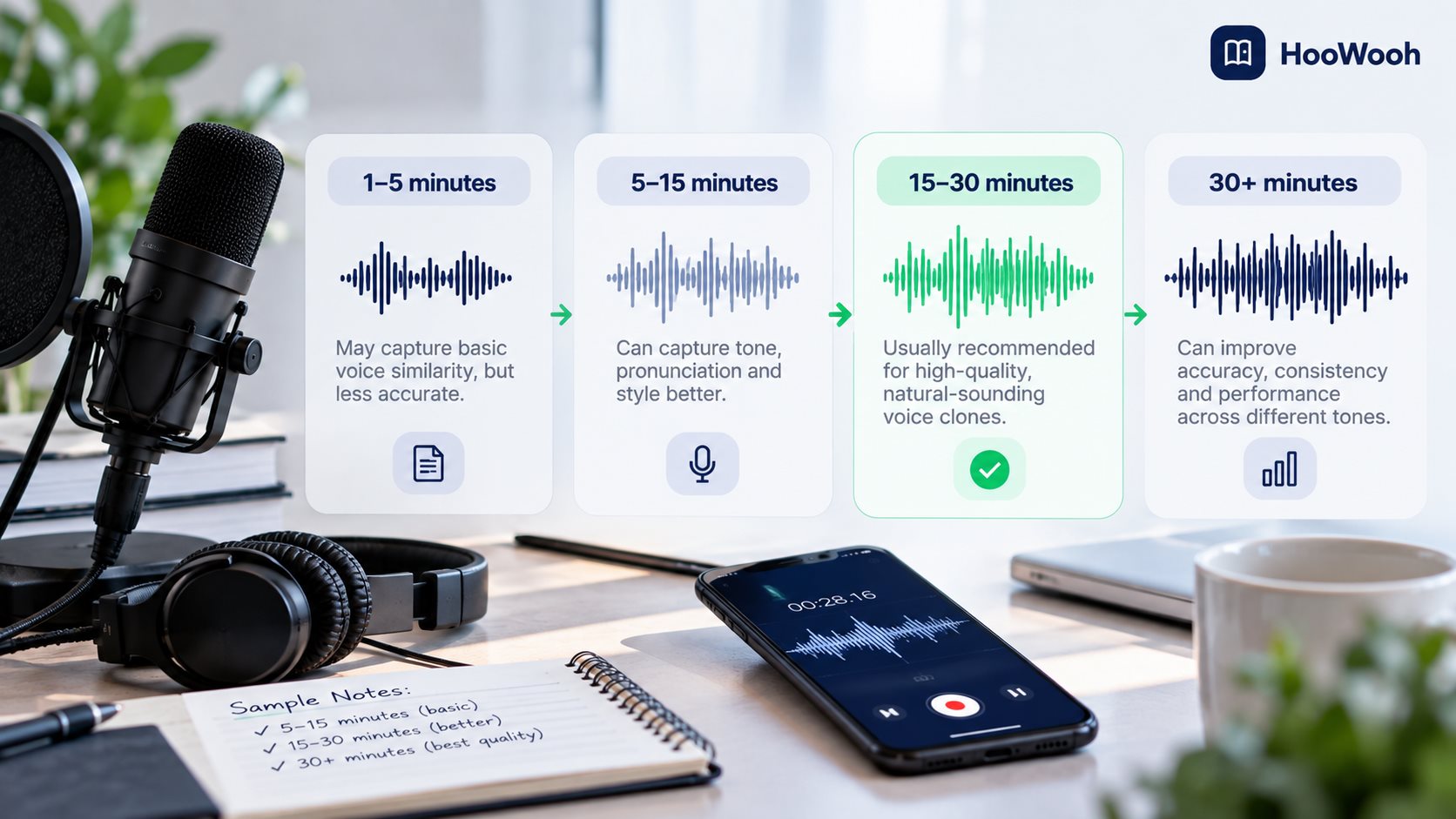
There is no universal number. The amount depends on the model, the platform, the expected quality, the language, and how varied the recording is. A short clean sample can sometimes demonstrate a recognisable voice, but consistent long-form narration may demand more information.
Quality also matters as much as duration. Ten minutes of clear, single-speaker speech may contain more useful information than a longer file filled with music, noise, interruptions, or several people talking. Variety helps too because a speaker sounds different while asking a question, telling a story, speaking softly, or stressing an important point.
For Hoowooh specifically, the current guidance is roughly 40–50 minutes of clear audio from the person whose voice is being cloned. You can review Hoowooh’s current voice and audiobook features on the Hoowooh homepage.
Can AI Voice Cloning Copy Emotion and Accents?
AI can reproduce some patterns linked to accent, tone, pacing, and expression, but it does not experience emotion as a person does. A model can learn acoustic patterns that listeners associate with excitement, calmness, sadness, tension, or warmth. The final result depends on the model and the controls available in the product.
This difference matters for stories. A sentence such as “I never thought you would come back” could sound relieved, angry, shocked, or sad. The words alone do not fully explain the intended performance. Context-aware narration can help, but a human narrator can deliberately interpret subtext and make acting choices in a way that should not be reduced to simple voice matching.
Why Do Some AI-Cloned Voices Sound Robotic?
A recognisable voice is not automatically a natural performance. A system may capture vocal identity well but still produce awkward timing or expression. Problems can become more noticeable during a full chapter than during a short sample.
Poor source audio can hide important vocal detail.
Background noise or music can interfere with the speaker signal.
Unusual names and specialist terms may be pronounced incorrectly.
Long passages can reveal pacing or consistency problems.
Limited context can make emotional delivery feel mismatched.
AI Voice Cloning vs Text-to-Speech
Text-to-speech answers a broad question: how can written words become spoken audio? AI voice cloning answers an additional question: how can that speech carry the vocal identity of a particular authorised speaker? A standard AI voice generator may offer several built-in narrators without recreating anyone the user knows.
A custom AI voice is more personal. The system uses a real speaker sample to guide the generated output. That makes consent especially important because a recognisable voice is connected to a person’s identity. The technical ability to imitate a voice does not automatically give someone permission to use it.
How AI Voice Cloning Is Used in Audiobooks
Audiobooks are a natural long-form use for voice cloning. A parent might want an authorised version of their own voice for bedtime stories. An author may want to hear drafts read in a familiar voice. A listener may simply prefer a personal voice for books they are allowed to convert.
Hoowooh combines custom voice cloning with its wider audiobook workflow. Users can upload or scan supported book content, choose a narration style and voice, and generate audio. Hoowooh describes its approach as scenario-based narration, with changes in tone and pacing rather than flat reading. Learn more about the purpose behind this approach on About Hoowooh.
Long-form audio also shows why voice quality is only one part of the experience. Chapter structure, dialogue, pronunciation, pacing, and listening comfort all matter. A voice that sounds impressive for one sentence still needs to remain clear and consistent across hours of narration.
Is AI Voice Cloning Safe and Ethical?
The most important rule is simple: a realistic voice should not be treated as something anyone can freely copy. A voice can be used to represent a real person, so cloning it without clear permission can create privacy, impersonation, and trust problems.
Hoowooh states that consent is central to its custom voice feature and that custom voices are private by default. Its current product information also says uploaded voices belong to the user and can be deleted. Readers who want practical information about voices, cloning, privacy, and conversions can use the Hoowooh Help Center.
The issue becomes more sensitive when the speaker has died. Families may see a recreated voice as comforting, especially for personal memories or stories. Others may feel that a person who cannot consent should not be digitally recreated. There is no single emotional response that fits every family, so permission, prior wishes, context, and respectful use deserve serious thought.
Responsible Voice Cloning Checklist
Before creating a custom voice, think about both the technical quality and the person behind the recording. A simple checklist can prevent many avoidable problems.
Get clear permission from the speaker before cloning their voice.
Use clean recordings that you have the right to upload.
Keep private voice models and audio files protected.
Review generated speech before sharing or publishing it.
Be transparent when a cloned voice could be mistaken for a real recording.
What AI Voice Cloning Cannot Do Perfectly
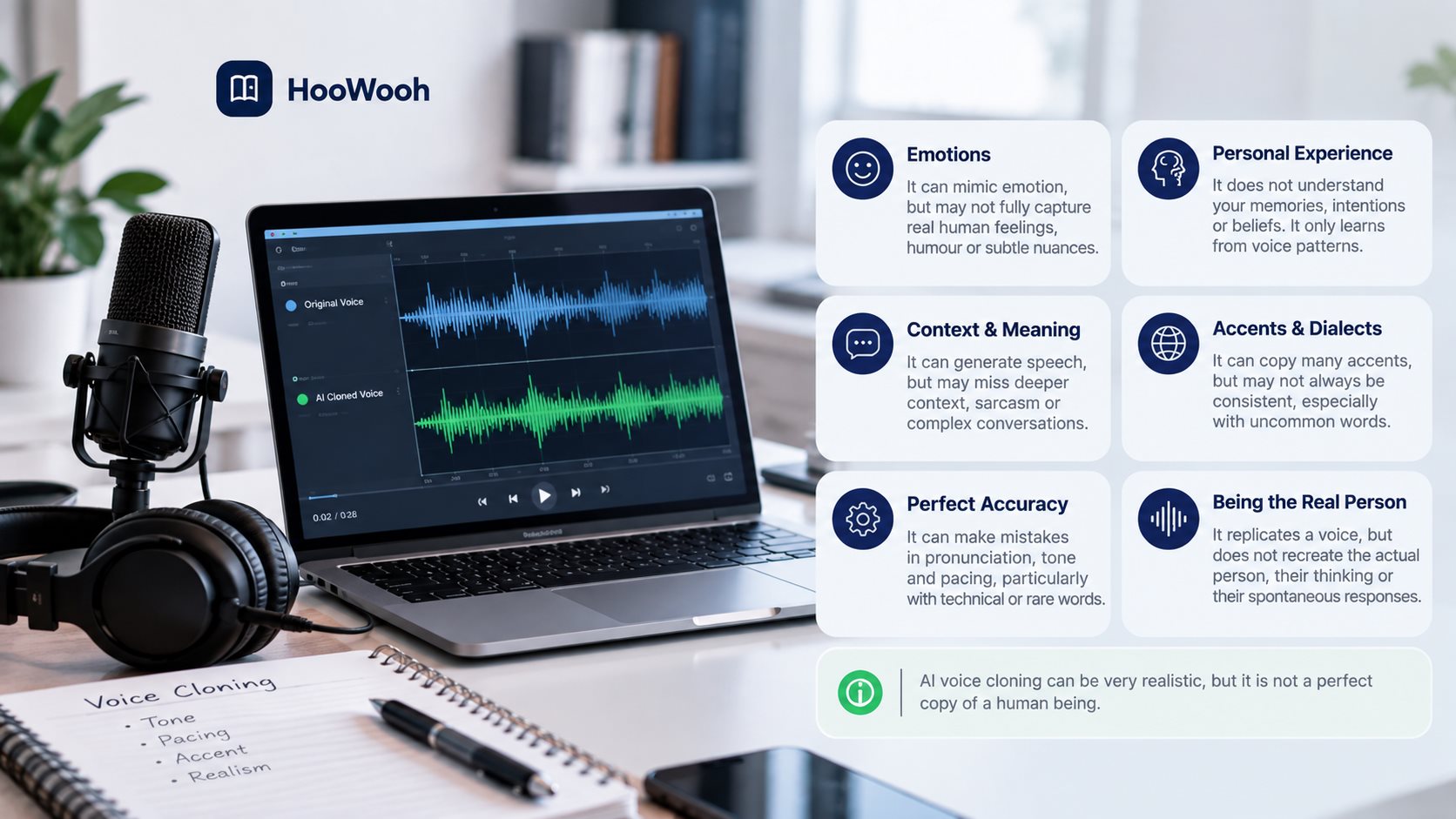
Voice cloning can be convincing, but it is not a perfect digital copy of a human being. A model may reproduce familiar vocal traits without understanding the speaker’s memories, intentions, humour, beliefs, or emotional state. It generates speech patterns; it does not recreate the person behind the voice.
It can also make mistakes. Pronunciation may drift. Emotion may feel too strong or too flat. An accent can become less consistent in unfamiliar words. Recording quality may affect the result. These limits are especially important when the audio will be heard for a long time or presented as professional narration.
That is why realistic AI voices should be judged across real use cases rather than one impressive sample. For audiobook narration, test dialogue, descriptive passages, names, numbers, and longer chapters before deciding whether the result works for the project.
Frequently asked questions
Can AI clone my voice from a short recording? Some systems can create a recognisable result from short audio, but requirements vary. More clean and varied speech can help a system capture a wider range of vocal patterns. Hoowooh currently asks for roughly 40–50 minutes of clear audio for its custom voice process.
Can AI voice cloning reproduce emotions? It can reproduce speech patterns associated with emotion, such as changes in pace, pitch, emphasis, and energy. However, the AI does not feel the emotion. The quality of expressive delivery depends on the model, the text, the available narration controls, and context.
Can AI generate sentences I have never spoken? Yes. That is one of the main purposes of voice cloning technology. A pretrained speech system can generate new words and sentences while using a learned representation of the authorised speaker’s vocal identity. It does not require a recording of every sentence in advance.
Can you always tell whether a voice has been cloned? Not always. High-quality synthetic speech can sound convincing, especially in short clips. That is one reason transparent labelling and responsible use matter when generated audio could reasonably be mistaken for a genuine recording of a real person.
Is it okay to clone someone else’s voice? You should have clear permission from the speaker and follow the rules that apply to the platform and intended use. Laws and rights can vary by location and context. For personal and commercial projects alike, consent is the safest starting point and an important ethical requirement.
Conclusion
Understanding How AI Voice Cloning Works makes the technology less mysterious. A system analyses authorised voice samples, represents important vocal patterns, and combines that information with speech synthesis to generate new sentences. The best results still depend on clean audio, strong models, careful review, and responsible use.
For audiobooks, a custom AI voice can make listening more personal, but the voice should always be used with permission and respect. Hoowooh brings consent-based custom voices together with scenario-based audiobook narration, giving readers another way to hear books in a voice that matters to them. Explore Hoowooh and see how your books can become listenable stories.