
How to Choose an Audiobook Narration Style begins with one question: what kind of listening experience does your book need? A strong choice fits the point of view, characters, dialogue, emotional tone, and production goals. This guide explains the main narration formats and how to test them before creating a complete audiobook.
What Is an Audiobook Narration Style?
An audiobook narration style is the way a written book is performed in audio. It includes who tells the story, how characters are separated, how expressive the delivery feels, and whether the production uses one voice, several voices, music, or sound design.
Two audiobooks can use the same text and still feel very different. One may use a calm single narrator who makes small changes for each character. Another may give major characters separate performers. A third may add sound effects and music for a more dramatic experience.
The right choice is not simply the most elaborate option. It is the format that helps listeners follow the story without making the performance feel distracting or confusing.
Why Narration Style Changes the Listening Experience
Readers can see paragraph breaks, quotation marks, names, and scene changes on a page. Audiobook listeners depend more heavily on sound. The narrator voice must help them understand who is speaking, where the mood changes, and when the story moves between perspectives.
A clear narration format can make a long book easier to follow. Poor voice selection can do the opposite. Characters may sound too similar, emotional scenes may feel flat, or dramatic effects may compete with the words.
That is why choosing audiobook narration should happen before full production. A short test can show whether the planned voice system still feels natural after several minutes of prose and dialogue.
The Main Types of Audiobook Narration
Single Narration
Single narration uses one performer for the whole book. The narrator may keep a fairly consistent voice or make controlled changes for different characters. This format can create strong continuity because the listener stays with one central performance from beginning to end.
A single narrator can still make dialogue easy to follow. Character distinction may come from rhythm, pitch, energy, phrasing, or a light accent rather than a completely new voice for every person.
Dual Narration
Dual narration normally uses two narrators who alternate by chapter, section, or point of view. In a book with two central perspectives, each narrator may handle one character's sections while also reading the dialogue that appears inside those sections.
This can make viewpoint changes easy to recognise. However, the same supporting character may sound different when performed by each narrator, so voice consistency deserves attention.
Duet Narration
Duet narration assigns voices more consistently by character. For example, one performer may voice a particular lead character even when that character speaks inside another narrator's section.
This approach can strengthen character identity in dialogue-heavy stories. It also needs careful coordination so timing, pronunciation, tone, and recording quality feel like parts of the same production.
Full-Cast Narration
Full-cast narration uses several performers, often with different actors assigned to major characters. It can work well for ensemble stories in which many characters have important speaking roles.
The trade-off is complexity. More performers mean more decisions about casting, pronunciation, pacing, editing, and voice consistency. A bigger cast does not automatically make an audiobook easier to listen to.
Dramatised Narration
Dramatised narration can combine multiple voices with background music, ambience, or sound effects. The result can feel closer to an audio drama than a traditional audiobook.
Some stories benefit from this immersive approach. Other books work better when the words remain the main focus. The amount of production should serve the story rather than compete with it.
Dual vs Duet Narration: What Is the Difference?
Dual and duet narration both use more than one voice, but they organise those voices differently. In dual narration, performers commonly alternate according to viewpoint or section. Each narrator may voice all characters that appear in the section they are reading.
In duet narration, performers tend to keep their assigned character roles across scenes. If Character A speaks during Character B's chapter, Character A can still be performed by the same voice.
The distinction matters because it changes how consistent characters sound. Dual narration can make viewpoint shifts very clear. Duet narration can make dialogue identity more stable. The book's structure should guide the decision.
Start With the Book's Point of View
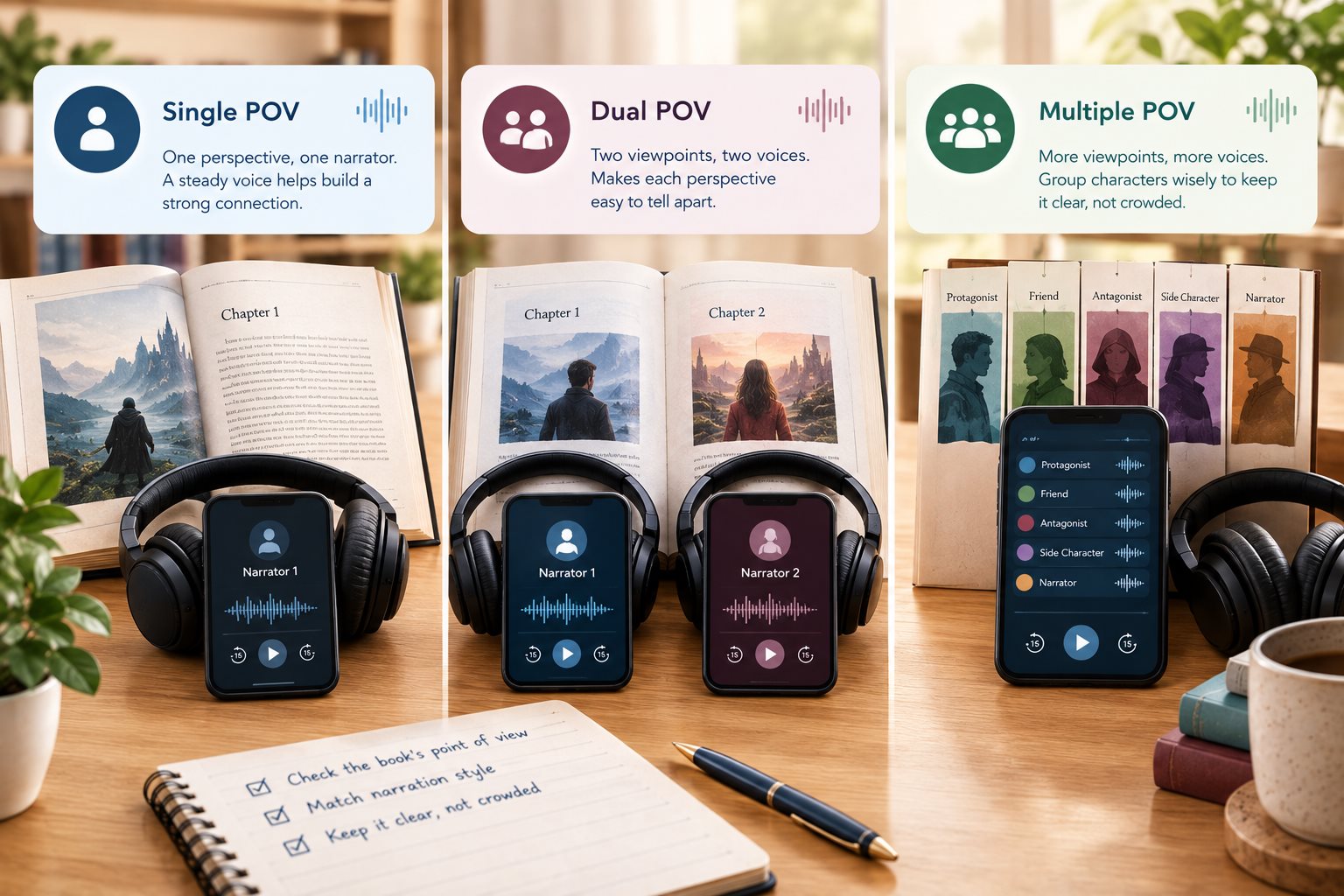
Point of view is one of the best starting points when learning How to Choose an Audiobook Narration Style. Instead of asking which format sounds most impressive, look at how the story is organised on the page.
Single POV
A book built around one central perspective often works naturally with one narrator. The listener can develop a stable relationship with that voice, while small performance changes can separate supporting characters.
Dual POV
Two clearly alternating viewpoints create a natural reason to consider two voices. Dual narration can make each perspective instantly recognisable. Duet narration may be worth testing when the two leads speak frequently inside each other's sections.
Multiple POV
Multiple POV books need extra care. A separate voice for every viewpoint can improve clarity, but too many performers may also make the production feel busy. Grouping voices thoughtfully can be more effective than assigning a new narrator to every named character.
Decide How Much Character Acting You Need
Character performance exists on a spectrum. At one end is a restrained narrator who uses subtle changes. At the other is strong voice acting with highly distinct character performances.
The best position on that spectrum depends on the writing. Fast dialogue may need clearer separation between speakers. Reflective prose may benefit from a steadier delivery. A children's story may allow more playful performance than a serious instructional book.
Do not judge character voices only by how impressive they sound in isolation. Ask whether they remain comfortable and believable over hours of listening.
Should One Narrator Use Different Voices for Every Character?
One narrator does not need a completely different theatrical voice for every character. Clear distinction can come from smaller changes in pitch, pace, rhythm, energy, or speech pattern.
Too little variation can make dialogue hard to follow. Too much can turn minor characters into distractions. The aim is recognition, not vocal competition.
For long-form narration, consistency matters more than novelty. A character introduced in chapter two should still feel recognisable much later in the book.
How Different Should Character Voices Sound?
Start with the characters who matter most. Lead characters need the clearest identity because listeners hear them repeatedly. Minor characters may need only a small shift in delivery.
Think about age, personality, confidence, energy, background, and emotional state without turning those traits into exaggerated stereotypes. Pronunciation and speech rhythm can also create separation without forcing the narrator into an unnatural pitch.
When using AI narration, save the settings or voice choices used for recurring characters. This helps prevent voice drift between chapters.
Choose the Right Level of Emotion
Emotion helps narration feel connected to the story, but more emotion is not always better. A narrator who pushes every sentence can make quiet moments feel exhausting. A voice that never changes can make important scenes feel distant.
A useful scale is neutral, conversational, expressive, and dramatic. Informational writing may sit closer to neutral or conversational. Character-driven fiction may need more expression. Highly produced storytelling may move further toward dramatic performance.
Listen to transitions between calm and intense scenes. A good emotional tone should follow the writing instead of staying at one level throughout the book.
Should Audiobooks Use Accents?
Accents can help establish character or setting, but they need restraint and consistency. An accent that sounds convincing for one line may become difficult to sustain for an entire book.
Before using one, test longer dialogue, emotional passages, and difficult names. Make sure the performance stays understandable. If an accent becomes a distraction, a lighter regional suggestion may work better than a heavy imitation.
With AI narration, pronunciation controls can help with names and specific terms, but every important recurring word should still be checked in context.
Should Audiobooks Have Music and Sound Effects?
Music and sound effects change the production from simple narration toward a more cinematic listening experience. They can establish atmosphere, support scene changes, or add energy to dramatic moments.
They can also cover speech, interrupt concentration, or make a listener feel that the production is telling them how to react. This is especially important for people who prefer the words and narrator to remain central.
If sound design is part of the plan, use it with a clear purpose. Test the same passage with and without effects before committing to the style for the whole book.
When a Single Narrator Makes Sense
A single narrator often makes sense when the book has one dominant perspective, a strong central storytelling voice, or a straightforward structure. It also simplifies production because pronunciation, recording tone, and pacing can remain under one performance system.
This format can work for both fiction and nonfiction. The key question is whether one voice can keep dialogue clear and maintain enough variation to hold attention without sounding forced.
When Two Narrators Make Sense
Two narrators can be useful when a book has two central viewpoints, alternating sections, letters or documents from different speakers, or a structure where vocal separation helps listeners understand who is leading the scene.
Test both voices before production. A strong first narrator cannot compensate for a second voice that feels mismatched. Their recording quality, energy, pace, pronunciation, and emotional range should feel compatible even when their voices are intentionally different.
When Duet Narration Makes Sense
Duet narration is worth considering when character identity matters strongly across viewpoint changes. It can be especially useful in dialogue-heavy books where the same two or three characters speak throughout many chapters.
The advantage is continuity: a recurring character can keep the same voice wherever that character appears. The challenge is coordination. The final edit should sound like one coherent audiobook rather than separate performances placed next to each other.
When Full-Cast Narration Makes Sense
Full-cast narration can suit ensemble stories with several important characters and frequent interaction. It can give listeners immediate vocal cues and reduce the need for one narrator to create a large range of character voices.
However, full cast adds production decisions. More voices can mean more variation in volume, microphone sound, interpretation, and pacing. Use a larger cast because the story benefits from it, not simply because more voices seem more premium.
Why Voice Consistency Matters
Voice consistency helps listeners recognise characters without consciously thinking about the production. A name should be pronounced the same way across chapters. A character's accent should not suddenly change. Recording volume and sound quality should remain stable.
In multi-narrator work, create a shared pronunciation guide for names, places, invented terms, and technical language. Agree on general pacing and character interpretation before producing long sections.
AI audiobook workflows also need consistency checks. A voice model or setting may produce slightly different results across sessions, so recurring characters and important passages should be reviewed together.
Does Narrator Gender Need to Match the Character?
Not necessarily. Narrator gender is one part of voice selection, not a universal rule. A convincing performance depends on tone, perspective, clarity, character fit, and the overall sound of the book.
Some creators may prefer a voice that closely matches the central character. Others may prioritise a narrator who handles the full cast well. Test the result rather than relying on a fixed assumption about what the narrator should sound like.
Should the Author Narrate Their Own Audiobook?
Author narration can feel personal, especially in memoir, essays, self-help, or nonfiction where the author's own delivery adds context. Familiarity with the material can also help with names, meaning, and emphasis.
Writing and narration are still different skills. Fiction with a large cast or demanding dialogue may require stronger performance range than the author wants to provide. A professional or AI narrator may be more suitable when the priority is consistent character work and polished long-form delivery.
The decision should be based on the listening result. Record a realistic sample rather than assuming that knowing the book automatically makes someone the best narrator for it.
How Narration Style Changes Between Fiction and Nonfiction
Fiction often asks the narrator to support character identity, dialogue, tension, and emotional movement. Nonfiction usually places more weight on clarity, authority, pacing, and making information easy to follow.
That does not mean fiction must be dramatic or nonfiction must be flat. Memoir can be deeply expressive, while some literary fiction works beautifully with restrained narration. Treat genre as context, not a rigid formula.
This keeps the article separate from a genre-by-genre narration guide. The stronger decision comes from the actual structure and purpose of the book.
How to Choose an AI Audiobook Narration Style
AI narration makes testing especially useful because creators can compare several voice directions before generating a complete book. Start with the role the voice needs to play, then judge whether the model can sustain that role across prose, dialogue, emotion, and long chapters.
Do not select an AI voice only because the first sentence sounds realistic. Long-form narration reveals different issues: repeated cadence, unstable pronunciation, weak emotional transitions, or character voices that become inconsistent.
Hoowooh creators can use short, representative tests to compare narration choices before committing to a full audio workflow. The goal is not simply a realistic voice. It is a voice system that remains clear, comfortable, and suitable for the book.
What to Test Before Choosing Your Narration Style
- Test ordinary narrative prose to hear the narrator's natural long-form rhythm.
- Include dialogue between at least two important characters to check voice separation.
- Use an emotional scene to see whether expression feels natural rather than exaggerated.
- Include difficult names, invented words, dates, numbers, or technical terms that may cause pronunciation problems.
- Test a viewpoint or scene transition if the book changes perspective.
How to Test a Narration Sample Properly
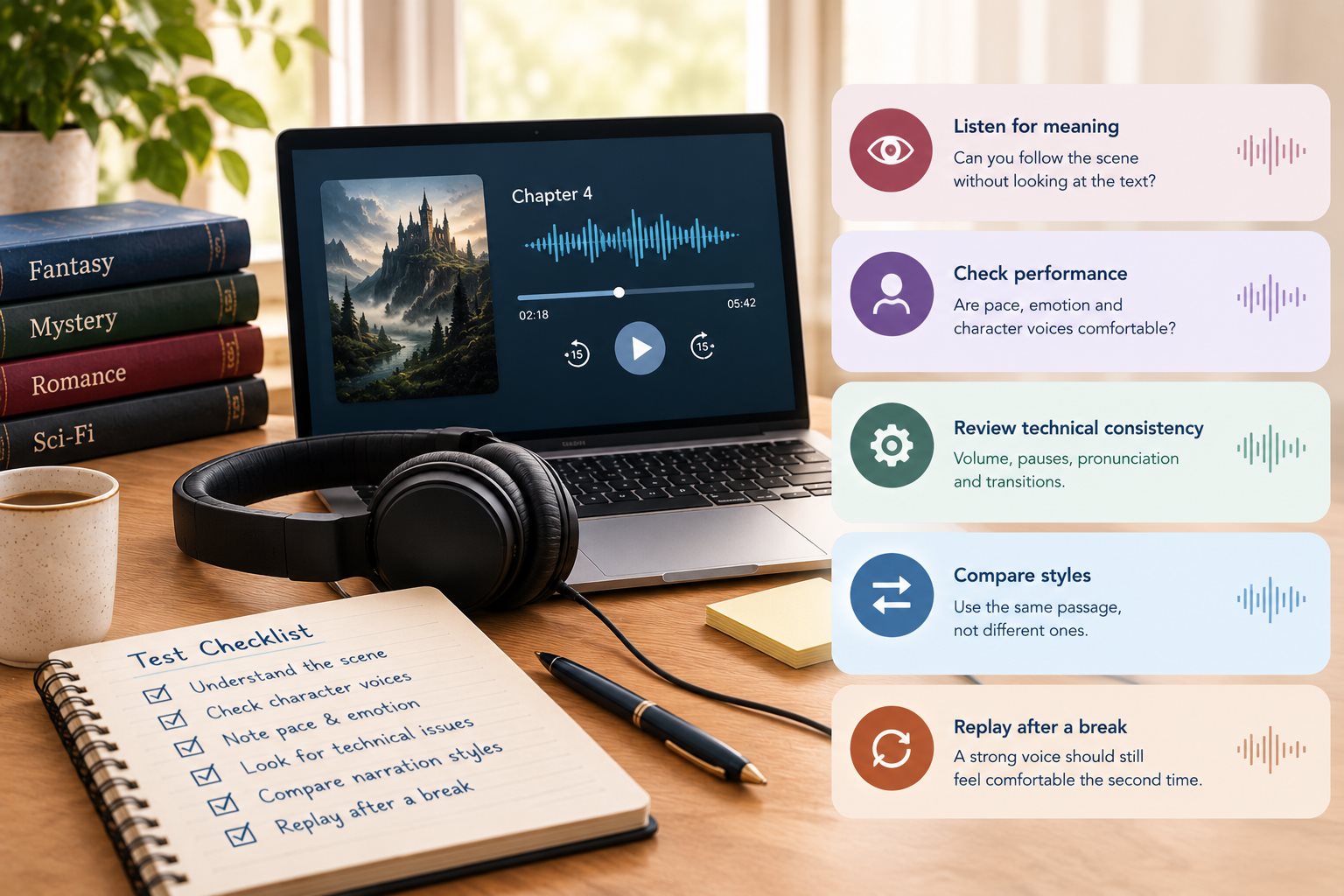
A polished opening paragraph is not enough. The sample should represent the parts of the book that are hardest to narrate. A five-minute test containing only exposition may hide problems that appear as soon as two characters begin speaking.
- Listen once for meaning: can you follow the scene without looking at the text?
- Listen again for performance: are pace, emotion, and character differences comfortable?
- Check technical consistency: volume, pauses, pronunciation, and transitions should not jump unexpectedly.
- Compare two or three narration approaches using the same passage rather than different passages.
- Wait briefly and replay the sample. A voice that sounds impressive at first should still feel comfortable on a second listen.
Common Audiobook Narration Style Mistakes
Many narration problems come from choosing a format for novelty instead of matching it to the book. A simple production can sound professional when every choice is consistent, while an elaborate production can become tiring when too many elements compete.
- Choosing a voice from one sentence instead of testing long-form narration.
- Giving every minor character an exaggerated voice that distracts from the story.
- Using dual narration without checking how recurring characters sound across both performers.
- Adding background music or sound effects that compete with spoken words.
- Changing pronunciation, pace, accent, or emotional tone between chapters.
- Producing the full book before testing dialogue, difficult names, and viewpoint changes.
Quick Audiobook Narration Style Guide
| Style | How It Works | Useful When | Main Consideration |
|---|---|---|---|
| Single | One narrator handles the book | Strong central voice or simple structure | Character distinction |
| Dual | Narrators alternate sections or POVs | Two major perspectives | Voice consistency |
| Duet | Performers keep assigned character roles | Dialogue-heavy stories | Coordination |
| Full cast | Several performers voice characters | Ensemble stories | Production complexity |
| Dramatised | Voices plus music or sound design | Highly produced experience | Effects can distract |
Frequently asked questions
What Is the Best Audiobook Narration Style? There is no single format that fits every book. Start with point of view, number of important characters, amount of dialogue, emotional tone, and desired production level. Then test a representative passage before choosing the final narration format.
What Is the Difference Between Dual and Duet Narration? Dual narration commonly alternates narrators by section or point of view, and each narrator may perform all dialogue in that section. Duet narration keeps performers more consistently assigned to particular characters across scenes.
Should One Narrator Use Different Voices for Each Character? A single narrator should usually make important speakers easy to distinguish, but every character does not need an extreme new voice. Small changes in rhythm, pitch, energy, and phrasing can be enough.
Is Full-Cast Narration Better Than a Single Narrator? Neither format is automatically better. Full cast can help an ensemble story, while a single narrator can create excellent continuity. Choose according to the structure of the book and the listening experience you want.
How Do I Test an AI Narrator Before Creating a Full Audiobook? Use a sample that includes prose, dialogue, emotional changes, difficult names, and any viewpoint transitions. Listen for clarity, natural pacing, pronunciation, character separation, and consistency before generating long sections.
Choose a Narration Style That Serves the Story
How to Choose an Audiobook Narration Style is easier when you stop looking for one format that is best for every listener. Start with the book's point of view, character structure, dialogue, emotional tone, and production goals. Then compare single, dual, duet, full-cast, or dramatic narration using the same representative material.
For AI audiobook production with Hoowooh, test before you scale. A short sample can reveal whether the narrator voice stays clear, characters remain consistent, pronunciation works, and the emotional tone suits the writing. Choose the style that makes the book easier and more enjoyable to hear, then build the full narration around that tested direction.